
AI is already inside the enterprise.
Recent data on leading business AI use cases shows that AI is most widely applied in coding assistance, writing support, knowledge retrieval, and meeting transcription. High-impact use cases but largely individual productivity layers.
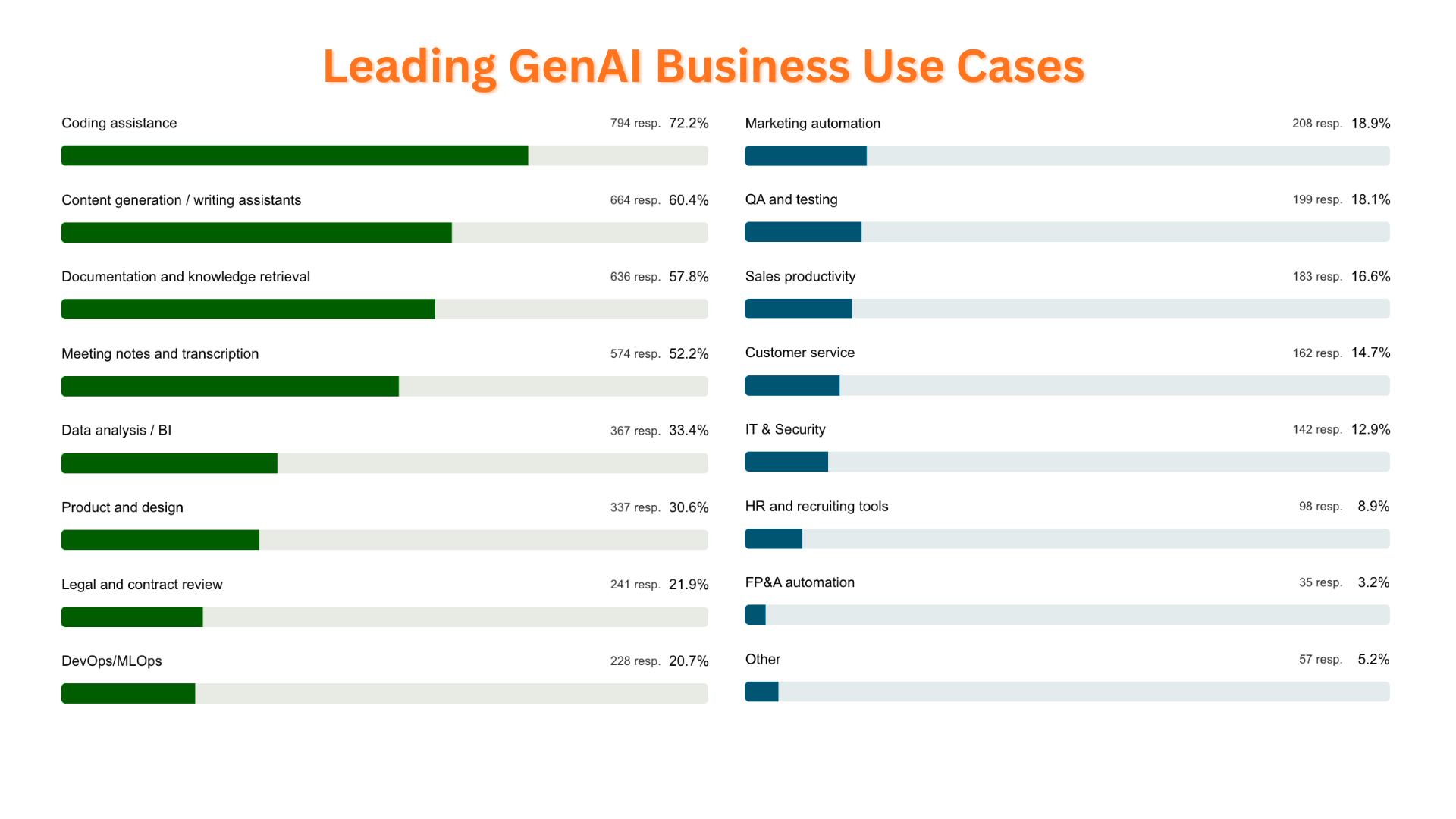
But notice the pattern: AI is entering organizations from the bottom up.
And that’s where confusion begins. Productivity gains are not the same as enterprise AI transformation.
Individuals using AI ≠ enterprises using AI
A company can have widespread AI usage and still rely on legacy decision flows, fragmented data systems, manual oversight, and reactive governance. In that scenario, AI improves tasks but it does not reshape how the enterprise operates.
This distinction between AI usage and AI transformation matters because:
AI becomes transformative only when it is embedded into the organization’s operating structure. Otherwise, it remains an assistive layer.
In enterprise terms, operating structure is how work flows, how decisions are made, and who is accountable for outcomes. It includes the sequence of tasks, approval chains, compliance controls, data validation, and performance measurement.
The organizations moving fastest share one pattern. They are not building enterprise AI from scratch, nor buying off-the-shelf tools that don't fit their constraints.
They are embedding AI into one critical workflow at a time, with AI implementation partners who understand the operational, governance, and data realities of production-grade AI.
For enterprise leaders who want to build, operationalize, and scale AI capabilities across the organization, this guide covers what AI transformation actually requires and where most organizations stall before achieving it.
-
01
AI usage ≠ AI transformation. Many enterprises already use AI tools for writing, coding, or research. Transformation happens only when AI becomes part of how decisions are made and how work actually flows.
-
02
AI transformation follows a layered value path. It usually starts with operational efficiency, then improves decision quality, stabilizes workflows, accelerates innovation, and eventually enables entirely new business models.
-
03
Enterprises must choose between build, buy, or co-create. Strategic AI capabilities tied to competitive advantage should be built or owned, commodity capabilities can be bought, and workflow-specific intelligence is often best co-created with specialized partners.
-
04
Transformation starts with one high-impact workflow. Instead of launching dozens of pilots, successful companies embed AI deeply into a single decision-heavy workflow and prove real operational value first.
-
05
Most AI initiatives fail because they never integrate into actual work. Lack of governance, unclear ownership, poor data readiness, and weak workflow integration prevent technically strong AI models from creating lasting business value.
*Click on any title below to jump to the section you care about.*
Here's what's covered:
I. Foundations
- What is AI Transformation?
- Why is it urgent now?
- What is the cost of ignoring it?
- What is it actually meant to deliver?
II. Strategy
- Are You Ready to Scale AI or Still in Pilot?
- Who Owns the Decision When AI Is Involved?
- Build, Buy, or Partner? A Practical Decision Framework
- What does AI Transformation demand from leadership and people?
III. Execution
- How to identify AI transformation use cases?
- What should the first 90 days of AI Transformation look like?
- Where AI should not be used yet?
- Why do most AI Transformation initiatives fail?
For a practical example of what all this looks like in production, see the:
IV. Final Note: Operationalizing AI Without Starting From Scratch
V. FAQs
Foundations
What does "AI Transformation" actually mean?
AI transformation is when AI stops being casually used on the side and becomes what an organization depends on to run its work. It changes:
- How decisions are made (AI helps analyze data and guide choices)
- How tasks are done (AI handles parts of the work automatically)
- How results are achieved (humans and AI work together to deliver outcomes)
At this point, some of you are probably thinking: "Wait! Haven’t we already done this? Isn’t this just digital transformation all over again?"
Here's a quick table to see the difference side-by-side:
| Aspect | Digital Transformation | AI Transformation |
|---|---|---|
| Core Driver | Connectivity, software platforms, and cloud infrastructure | Intelligence powered by algorithms and data |
| Primary Goal | Efficiency, reach, and automation of existing tasks | Augmentation, prediction, innovation, and autonomous decision-making |
| Key Question | “How do we do this digitally?” | “What should we do next, and how can AI help us do it?” |
| Output | Streamlined processes and digital channels | Adaptive systems, personalized experiences, and new products or insights |
| Data Use | Data is stored, accessed, and reported on | Data is learned from to make predictions and generate content |
| Typical failure mode | Technology adoption without sustained usage | AI pilots that never translate into real execution |
| Governance needs | Access control, system stability, and compliance | Explainability, trust, and in-workflow controls |
To make that shift real, consider what it looks like in practice.
- A financial services company embeds an AI agent inside its email workflow.
- Before any outbound message is sent, the agent checks it against compliance rules and flags anything that could go against brand guidelines.
- It also auto-suggests tone-safe corrections before sending the email.
That's the difference between AI assistance and AI transformation. An assistive tool might help a sales rep draft better emails. A transformed workflow makes compliance validation a built-in step of execution (automatic, standardized, and embedded into the operating process).
And the path to building it matters as much as the outcome.
Most enterprises that get there don't build it entirely from scratch, nor do they buy something off-the-shelf that doesn't fit their constraints.
They co-create, embedding AI into one critical workflow at a time, with partners who understand their data, their governance requirements, and what production-grade actually means inside a regulated environment. Platforms like Gyde are built specifically for this co-creation path.
*Distinction between (build, buy, or co-create) is covered later in this guide.*
Why is AI Transformation Urgent now?
This moment is different from previous technology waves. Several forces are converging at once.
1. AI Is Starting to Do Knowledge Work
- Earlier, AI was mostly used to automate simple and repetitive tasks like sorting data or sending tickets to the right team. Now AI can help with more complex work that usually required human thinking. Think reviewing legal documents, analyzing financial reports or checking code.
- This means AI is no longer limited to small tasks. It is starting to handle parts of important business work. Goldman Sachs estimates that generative AI could automate up to 15% of current work tasks in the US and Europe.
- Enterprises are at a tipping point where AI-driven efficiency in knowledge work has become the new baseline. For businesses, the clock is ticking because the 'near future' competitive advantage belongs to those who operationalize these tools today.
2. Shadow AI Is Already Spreading Inside Organizations
- In many organizations, employees are already using AI tools to complete tasks faster. Research from the Microsoft Work Trend Index found that 78% of employees who use AI at work bring their own tools, rather than using company-provided ones.
- This trend is often called Shadow AI — when employees use AI tools independently because official systems or policies are not yet in place.
- When AI is used informally across teams, organizations lose visibility into how it is being used, what data is being shared, and how outputs influence business decisions. This creates urgency for companies to introduce structured AI systems and governance inside enterprise workflows.
3. The Time to Prepare Is Getting Shorter
- Earlier technology shifts like cloud computing and mobile took many years to spread across industries. AI is moving much faster. New AI models and capabilities are improving every few months.
- At the same time, governments are starting to introduce rules and regulations for how AI should be used. For example, the EU AI Act is already in force, and countries like the US, UK, and Singapore are developing their own AI policies.
- This means organizations have less time to prepare. Organizations that engage now shape their governance posture. Those that wait inherit requirements they didn't design for.
AI transformation is not driven by hype. Companies using AI today are improving their capabilities every day. The longer organizations wait, the harder and more expensive it becomes to catch up.
The Cost of Ignoring AI Transformation
Ignoring AI transformation doesn’t hurt overnight. It erodes advantage gradually.
AI-enabled competitors reduce costs, shorten cycle times, and raise customer expectations. This will eventually result in shift of customer expectations (might even snowball into market share erosion).
Talent follows momentum. Skilled practitioners move toward AI-forward companies. Capability gaps widen. Business models begin to look outdated.
The risks vary by company size.
- Large enterprises struggle with legacy complexity. Scale turns into technical debt. Protecting existing revenue slows bold investment. Layered approvals stall experimentation.
- Small and mid-sized companies face different constraints. Limited capital leads to hesitation. Competing for AI talent becomes harder. AI-enabled partners prioritize more advanced organizations.
In financial services, marketing, and customer support, the pressure is already evident. Decision speed, personalization, and risk detection are outpacing traditional operating models.
Manufacturing, healthcare, and retail are close behind, as predictive maintenance, operational optimization, and personalization mature. Others (education, agriculture, construction) have more time. But none are immune.
AI transformation isn’t urgent because it’s fashionable or trendy. It’s urgent because the cost of waiting compounds faster than the cost of starting.
What AI Transformation Is Actually Meant to Deliver?
When AI transformation works, you can see it in day-to-day operations: lower costs, faster cycles, fewer handoffs, and decisions that don’t keep getting revisited. These outcomes don’t appear all at once. Most enterprises reach them in layers.
A. Operational efficiency
- This is the most immediate and measurable layer.
- AI is used to reduce manual effort, speed up processes, and lower error rates.
- Claims get processed faster. Quality checks move upstream. Supply chains respond with fewer delays.
- The gains are real and often easy to justify. But efficiency alone plateaus. It creates capacity.
B. Consistency in decisions & outcomes across teams
- The next shift occurs when AI moves beyond automation and begins to influence decisions.
- Forecasts become more accurate.
- Risks are identified earlier.
- Exceptions are flagged before they turn into incidents.
- Decisions rely less on static rules or intuition and more on continuously updated signals.
C. Experience improves because workflows stabilize
- As decision-making becomes clearer, experience naturally improves.
- Customers receive faster, more relevant responses.
- Employees spend less time context switching because guidance is embedded within the workflow rather than in separate tools.
- Work moves faster because fewer decisions are stalled or reversed later.
D. Innovation accelerates as a consequence
- Once AI is embedded into everyday workflows, innovation stops being a separate initiative.
- R&D cycles shorten. New features ship faster.
- AI becomes part of the product or service itself.
- Innovation becomes continuous rather than episodic.
E. New business models become viable
- At the final layer, AI changes how value is created.
- Products evolve into services.
- Outcomes matter more than outputs.
- Data and intelligence become revenue drivers rather than byproducts.
The final layers only works because the earlier layers are in place. Efficiency creates capacity. Better decisions create leverage. Experience and innovation create differentiation.
Strategy
Are You Ready to Scale AI or Still in Pilot?
Most enterprises believe they’re “early but progressing.” In reality, many are stalled in a comfortable middle ground: successful pilots with no path to scale.
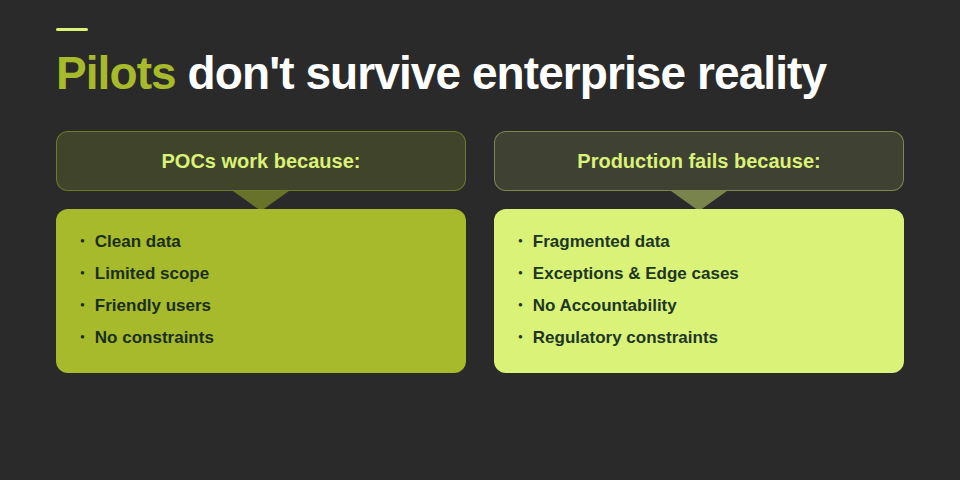
You can diagnose where you truly stand by answering a few uncomfortable questions.
You are likely not ready to scale if:
- AI systems work in demos but aren’t trusted inside real workflows.
- Business teams describe AI as “the data team’s project.”
- Success is framed as model accuracy, not decision quality or cycle-time reduction.
- Humans routinely override AI outputs, but no one tracks why.
You are closer to readiness if:
- A specific business leader owns outcomes, not just delivery.
- AI guidance shows up inside existing tools, not separate dashboards.
- Overrides, corrections, and exceptions are logged and reviewed.
- Governance rules are explicit and visible, not implied.
- People complain when the AI isn’t available.
Readiness is about whether intelligence is already shaping how work gets done, even in small ways.
Who Owns the Decision When AI Is Involved?
AI transformation quietly fails when accountability is not decided. In most enterprises, ownership defaults to the wrong place:
- Data teams own models.
- IT owns infrastructure.
- No one owns decision quality.
Before scaling any AI system, leaders must answer one question clearly: When AI influences a decision, who is accountable for the outcome?
In successful transformations: AI systems have a business owner.
That owner is responsible for:
- When AI is used
- When humans override it
- What happens when it’s wrong
Escalation paths are defined before incidents occur. If accountability can’t be named in one sentence, the system isn’t ready for production (no matter how well it performs in testing).
Own, Adopt, or Co-Create? A Practical Enterprise AI Decision Framework
Once you’ve identified where AI should operate inside your enterprise, the next decision is principal: How should you implement it?
Even if those decisions are still evolving, working with an AI transformation partner can help clarify priorities, evaluate options, and move from exploration to execution faster.
For C-suite leaders, this is a capital allocation and control question. It determines where differentiation is protected, where efficiency is optimized, and where liabilities are shared.
Here’s the practical filter.
1. Own the Intelligence (Build)
Enterprises should own the intelligence that directly shapes how they compete.
If the capability impacts:
- Customer experience
- Risk or pricing logic
- Approval decisions
- Proprietary operational workflows
then it encodes differentiation.
What makes the organization unique (its data, decision frameworks, heuristics, and institutional knowledge) must remain unique. That differentiation is preserved by building intelligence around proprietary data rather than exporting logic to external systems.
AI ownership in this context needs serious commitment to:
- Build custom models
- Implement internal data pipelines
- Establish governance and compliance controls
- Create monitoring and feedback loops
- Invest in the right AI, data, and engineering talent
It must be defensible to boards and executive committees because it carries long-term architectural responsibility.
It is also the hardest path to operationalize. Internal builds often struggle to move beyond pilot stages. Trust must be built among frontline users. Explainability must be demonstrated. Governance must be earned.
But when executed well, ownership protects competitive advantage.
2. Access the Intelligence (Buy)
Not every AI capability needs to be owned.
Horizontal capabilities (transcription, summarization, coding assistance, workflow automation) do not create advantage by themselves. They improve productivity, but they do not define competitive positioning.
In these cases, access is more rational than ownership.
Buying provides:
- Speed
- Reliability
- Lower operational burden
- Focus on core differentiators
The market already offers mature tools such as Microsoft Copilot, Zoom AI Companion, and Otter.ai.
Building a proprietary transcription or summarization engine would consume capital without strengthening differentiation. It would divert attention from areas where ownership actually matters.
For non-strategic capabilities, intelligent access is good discipline.
3. Co-Create the Intelligence (Partner)
The third category helps where most enterprises struggle.
Some AI capabilities are:
- Too domain-specific to buy off-the-shelf
- Too operationally heavy to build independently
- Deeply embedded in proprietary workflows
- Sensitive to governance and compliance standards
Examples:
- An underwriting AI agent using internal risk logic
- A CRM-embedded sales coach trained on real pipeline behavior
- A brand-compliance agent reviewing outbound communication before it is sent
These systems:
- Depend on enterprise data
- Require workflow integration
- Must align with internal guardrails
- Tie directly to measurable outcomes (cycle time, training quality, compliance, cost reduction)
This is what workflow-embedded intelligence looks like in practice. And it is where the constraints of the build and buy paths become clearest. The capability is too domain-specific to buy off-the-shelf.
The operational complexity makes building independently costly and slow. And the governance stakes are too high to outsource without a partner who understands the production environment.
AI transformation partners like Gyde are specifically for this category. They work with enterprises to build Specific Intelligence Systems (SIS)—AI systems designed for high-impact enterprise workflow.
Each SIS is built using the organization’s own data, rules, and operational context. This ensures the intelligence reflects how the business actually operates, rather than relying on generic models.
To develop the system, a dedicated POD team (typically five specialists including data engineers, AI experts, and workflow architects) works closely within the organization’s environment from day one.
The POD follows a repeatable approach:
- Identify one high-impact workflow
- Design intelligence specifically for that workflow
- Measure success based on the outcomes it produces
The system is built with all the infrastructure needed for production use—connectors, retrieval architecture, guardrails, and monitoring capabilities.
Because the process is structured and focused, the system can move from design to deployment in under four weeks.
The intelligence operates inside the tools teams already use. It may appear as a web application, a chat interface, or directly within existing enterprise workflows.
For organizations where co-creation is the right path, Gyde offers a structured model that protects data ownership and governance control while accelerating the distance from experimentation to operational AI.

What Does AI Transformation Demand From Leadership and People?
The table below shows how demands vary by organizational layer:
| Organizational Layer | Key Demands & Responsibilities | Essential Capabilities |
|---|---|---|
| Enterprise Executives (C-Suite) | Define where AI creates competitive advantage, set risk and ethical guardrails, align capital and incentives, and signal that AI is a business priority. |
|
| Business & Functional Leaders (VPs, Directors, BU Heads) | Redesign workflows, realign KPIs, absorb short-term disruption, and ensure AI improves outcomes. Translate strategy into execution. |
|
| Frontline Managers & Team Leads | Normalize AI usage in daily work, build team confidence, reinforce new habits, and escalate breakdowns early. Turn intent into consistent behavior. |
|
| Employees & Individual Contributors | Collaborate with AI inside workflows, validate outputs, apply judgment, and take accountability for final decisions. Shift from execution-only to oversight and interpretation. |
|
The bottomline here is that alignment across levels is non-negotiable.
- If the C-suite declares AI a priority but doesn’t use it in decision-making, the signal weakens. AI becomes optional.
- If mid-level leaders don’t redesign workflows, AI remains an add-on instead of becoming operational.
- If frontline leaders don’t build trust, employees quietly revert to old habits.
AI Transformation doesn’t fail dramatically. It fades through misalignment.
AI transformation succeeds when:
- Vision is clear at the top
- Work is redesigned in the middle
- Trust is built on the ground
Execution
How to Identify AI Transformation Use Cases?
When you’re aiming for AI transformation, you’re no longer asking, “What task can we automate?” You’re asking, “Where do better predictions or decisions materially change outcomes?”
That shift alone eliminates most weak use cases.
A. Start with decision-heavy workflows
- AI creates leverage where decisions are frequent, complex, and time-sensitive.
- Look for workflows where decision quality directly impacts revenue, cost, or risk.
- Find workflows where humans rely on intuition or simple rules because the data is overwhelming.
- Especially watch out for delays in decisions cause missed opportunities or downstream rework.
- If the decision matters and happens often, it’s a "prospect" use case.
Question to ask: Which important decisions today are made with partial information or heuristics?
B. Check if the data can actually teach something
AI needs examples. Strong use cases usually have:
- Historical outcomes (you know what happened after decisions were made)
- Multiple signals that can be correlated, not just one clean dataset
- Feedback loops where the system can learn if it was right or wrong
- Unstructured or underused data is often a plus, not a problem.
Question to ask: Do we have enough “good vs. bad” outcomes for the system to learn from?
C. Focus on Complexity That Erodes Human Consistency
AI creates structural advantage when decision environments become too complex for humans to process consistently.
These are situations where:
- Many variables influence outcomes
- Relationships shift over time
- Trade-offs are probabilistic
- Context changes frequently
Over time, humans simplify. They rely on experience, rough thresholds, or negotiation instincts. That works until scale increases or volatility rises. Performance then becomes inconsistent.
AI adds leverage because the interaction between variables exceeds what humans can reliably compute. This is where AI can stabilize and improve outcomes.
Question to ask:
Is decision performance limited by cognitive constraints rather than lack of expertise?
Where Transformation-Level AI Use Cases Actually Appear
Across enterprises, high-impact AI use cases consistently cluster in a few domains:
- revenue and growth (pricing and discount optimization in B2B sales, lead prioritization, next-best actions),
- operations (predictive maintenance, supply chain optimization, anomaly detection),
- risk and compliance (fraud detection, risk scoring, early warning systems), and
- talent and learning (attrition risk, skill mapping, adaptive learning).
These areas share one characteristic: the decisions made within them directly influence revenue, cost, or risk at scale.
They also generate rich feedback loops. Every deal won or lost, every machine breakdown, every flagged transaction, every employee exit creates outcome data.
Over time, this history becomes learnable signal. And in each of these domains, outcomes depend on many interacting variables — far more than humans can consistently process.
A simple test most organizations miss: If this AI system disappeared tomorrow, would the quality of decisions noticeably degrade? If the answer is no, it’s probably not a transformation use case.
What Should The First 90 Days of AI Transformation Look Like?
AI transformation does not begin with a five-year roadmap. It begins with the decisions leaders make in the next 90 days.
The organizations that move successfully from experimentation to operational AI typically focus on three structural shifts during this period:
1. Reduce AI Noise and Create Strategic Focus
Many organizations start their AI journey with dozens of disconnected experiments like multiple tools, scattered pilots, and isolated teams exploring use cases.
The first step is to reduce this noise.
Leaders pause broad experimentation and tool sprawl, consolidate initiatives, and narrow the focus to a smaller number of meaningful opportunities. Instead of running many pilots, the goal becomes going deep on one or two problems that matter operationally.
In the early stage of transformation, focus creates momentum.
2. Fund an End-to-End AI Workflow
The most effective organizations do not start with platforms or models. They start with a single workflow that is expensive, slow, or operationally complex.
The goal in the first 90 days is to take that workflow and implement AI end-to-end, which means addressing:
- Data readiness
- Governance and guardrails
- Integration inside existing tools
- Measurement tied to business outcomes
This first system becomes more than a pilot. It becomes a template for how AI systems will be built across the enterprise.
3. Shift the Internal Conversation About AI
AI transformation also requires a shift in how organizations think about the technology.
Many early conversations revolve around tools: “Which AI platforms are we using?”
But the more important question is operational: “Where is AI already influencing decisions—and where should it be?”
This shift moves the organization from AI tool implementation to AI workflow transformation.
Many of these first-90-day lessons mirror what surfaced in a GydeBites podcast conversation with Stuart Hiddema, Canada Post’s first AI Product Owner, on rolling out AI in large, complex organizations.
Where AI Should Not Be Used Yet
AI transformation accelerates when leaders set clear boundaries.
Avoid these moves early on:
- Don’t automate decisions you can’t explain: If you can’t justify a decision to a regulator, customer, or employee, AI shouldn’t make it yet.
- Don’t let AI operate without feedback loops: Systems that don’t learn from corrections will degrade, repeat mistakes, and lose trust.
- Don’t scale before humans trust the system: Forcing deployment through mandates backfires. Usage must grow because friction decreases, not because leadership demands it.
- Don’t treat AI as a headcount replacement strategy: Early framing around cost-cutting creates fear and resistance. Focus first on decision quality and workflow stability.
- Don’t start with customer-facing autonomy: Internal workflows are safer proving grounds. External-facing autonomy magnifies errors and reputational risk.
These boundaries aren’t permanent. They evolve as trust, governance, and capability mature. But ignoring them early creates damage that’s difficult to undo later.
Why Most AI Transformation Initiatives Fail
Despite widespread experimentation, most AI initiatives never move beyond the pilot phase to scaled, impactful AI implementations. Research consistently shows that fewer than half of organizations see a measurable impact on EBITDA from their AI initiatives, even as initial deployment continues to grow.
AI transformation doesn’t fail at some dramatic moment. It fails gradually, as initiatives move from intent to everyday use. In enterprise environments, each stage introduces a new set of failure modes that compound if left unaddressed.
| Failure Mode | Stage It Hits | Early Warning Signal |
|---|---|---|
| Starting with the solution, not the problem | Strategy | Teams can demo the AI but cannot name the business outcome it serves |
| No business owner for decision quality | Strategy | AI is described as “the data team’s project” |
| Success undefined or tied only to model accuracy | Strategy | No clear agreement on whether the initiative worked |
| Building everything at once | Strategy | Multi-year AI platform effort with no production use case after 12 months |
| Data fragmented, inconsistent, or locked | Build / Technical | Data issues discovered after model development has already begun |
| Model focus without production readiness | Build / Technical | Strong demo performance but no deployment plan |
| Legacy integration underestimated | Build / Technical | “Quick win” turns into a six-month engineering project |
| End users brought in too late | Adoption | AI adds steps instead of removing them; quiet workarounds emerge |
| Wrong talent mix | Adoption | Strong data scientists but no engineers to operationalize their work |
| AI funded as a project, not a capability | Adoption | Progress stalls when the initial budget cycle ends |
| Governance treated as a final step | Operations | Ethics, bias, and explainability surface only after the system is built |
| No feedback loop designed in | Operations | Model performance degrades, errors repeat, trust erodes |
Here's the pattern behind these pitfalls: Across all of these failures, one issue keeps showing up, AI is introduced without being embedded into how work actually runs. When workflows, ownership, governance, and feedback loops aren’t designed together, even technically sound AI systems struggle deliver lasting value. That’s why so many AI initiatives stall.
Final Note: Operationalizing AI Without Starting From Scratch
As discussed earlier, co-creating (partnering) is often the most practical way for enterprises to retain control over their data and move from AI experimentation to operational AI faster.
Enterprises don’t need to architect everything from scratch. They can partner with Gyde to navigate through their AI transformation journey. Gyde understands how AI behaves inside regulated, high-stakes environments and knows how to translate vertical high-impact use cases into production-grade systems.
Gyde builds Specific Intelligence Systems (SIS) — a focused AI system for a critical business problem. Each system is grounded in your proprietary data, business rules, and operational constraints.
Take an example of a ready-to-deploy use case like a Brand-Safe Email Agent.
- Context: Imagine you're a financial services company. Your compliance rules clearly state that no communication should imply guaranteed loan approval.
- Risk: Yet under pressure, sales teams might unintentionally overpromise.
- Where It Sits: The AI agent sits inside the email workflow. Before an email is sent, it checks the content against compliance standards.
- What It Does: If something crosses the line, it suggests tone-safe corrections. It can even apply compliant phrasing before the email hits “send.”

Over time, this reshapes outbound communication patterns. It reduces compliance exposure and builds institutional trust.
Now, the context and risk may differ across workflows (and so will where the AI sits and what it does).
How can Gyde help organizations in AI transformation at scale?
As the underlying data architecture, connectors, governance, and model configurations are already structured.
Gyde can build another SIS for underwriting, helping reviewers validate loan forms against internal risk logic. Or a real-time sales roleplay agent embedded inside CRM workflows to improve customer conversations as they happen.
The foundation is already built. We configure it around any of your workflow.
FAQs
Q. What are the early warning signs that an AI transformation is stalling?
A. Here are some early signs:
- AI works well in demos but is rarely used in live workflows
- Business teams refer to AI as “the data team’s project”
- Humans frequently override AI outputs, but reasons aren’t tracked
- Success is measured by model accuracy, not decision quality or cycle time
- Turning the AI system off would not materially change outcomes
Q. How do enterprises measure ROI from AI transformation beyond cost savings?
A. Below are some ways enterprise measure ROI:
- Reduction in decision and approval cycle times
- Fewer escalations, exceptions, and rework
- Improved consistency of outcomes across teams or regions
- Better forecast accuracy and earlier risk detection
- Capacity creation (higher-value work without proportional headcount growth)
- Performance degradation is noticeable when AI is unavailable
Q. What is the difference between using AI tools and building AI capabilities?
A. AI tools improve individual productivity and experimentation. AI capabilities are embedded into workflows and owned by the business. Capabilities include governance, feedback loops, monitoring, and escalation paths. Tools create fragmented usage; capabilities create repeatable impact. AI transformation happens when intelligence accumulates over time.
Q. Can enterprises scale AI transformation without replacing existing systems?
A. Yes—most successful transformations avoid early system replacement. AI is embedded into existing tools via integrations and event triggers. Intelligence operates as a decision-support layer, not a replacement system. This reduces risk, speeds adoption, and preserves operational stability. Deeper modernization happens later, once trust and value are proven.
Q. Who should own AI transformation inside an enterprise?
A. Remember, if ownership can’t be named clearly, the system isn’t ready to scale. Here are points to remember:
- Ownership must sit with a business leader, not IT or data teams
- The owner is accountable for decision quality and outcomes
- Responsibilities include override rules, escalation paths, and success metrics
- Data and IT support delivery, but do not own impact