
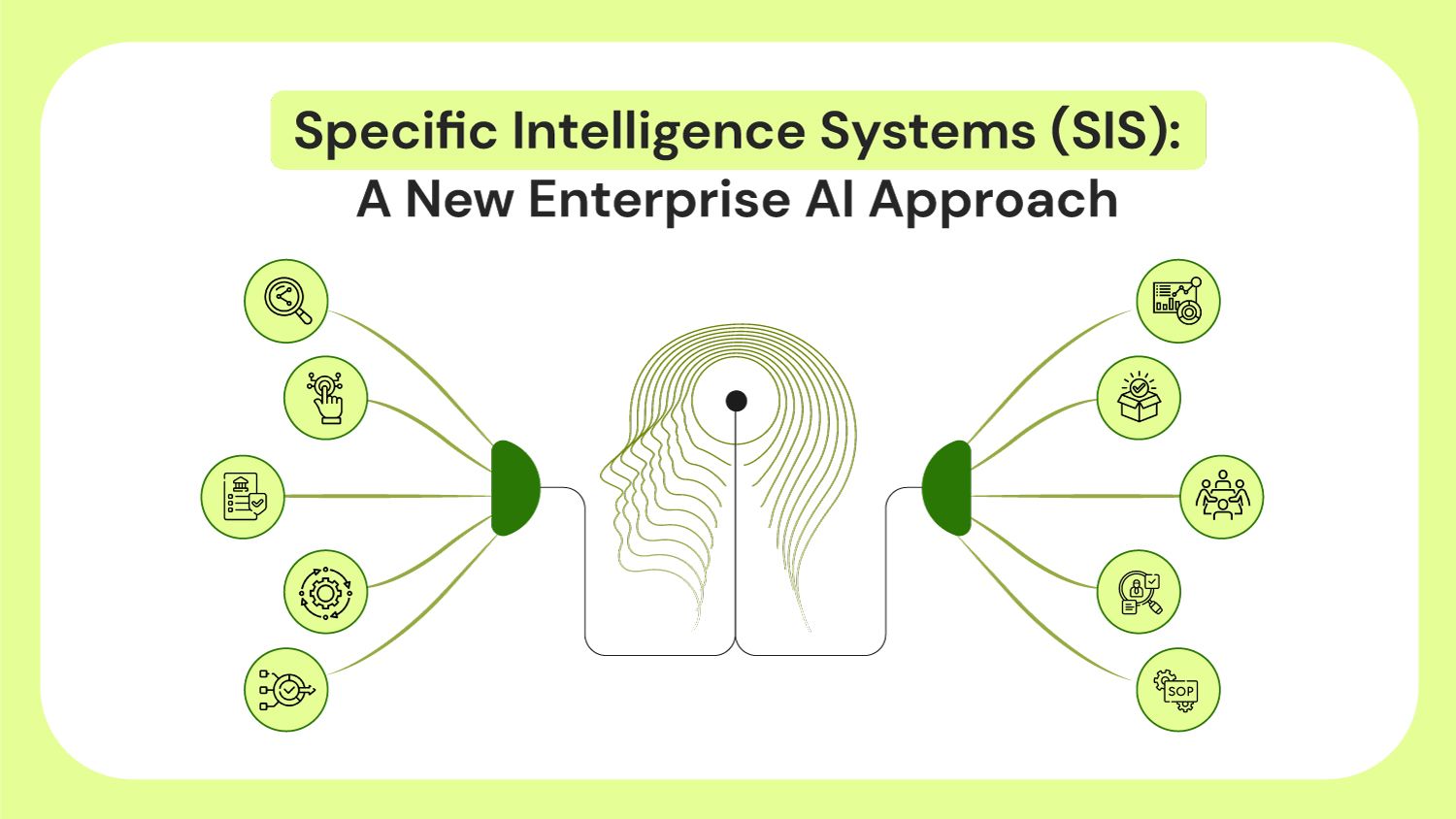
Most companies try to teach AI everything. The ones who actually win teach it one thing.
Every enterprise has an AI strategy right now. Chatbots. Copilots. Automation dashboards. More platforms that promise to "transform" sales, compliance, operations, and customer support (all at once).
And yet, 70 to 85% of AI projects still fail to deliver. Only about one in four AI initiatives actually delivers its expected ROI, and fewer than 20% have been fully scaled across the enterprise.
When you ask an AI system to be intelligent about everything, it ends up being reliable about nothing. Broad authority create brittle systems (which are then) hard to govern, harder to trust, and almost impossible to put into production.
But there's a new & different approach. It's not a bigger model or a better prompt. It's a design philosophy — one that says: pick one high-stakes operational problem, and build a system that solves exactly that.
It's called a Specific Intelligence System. And it might just be the most important architectural idea in enterprise AI right now.
-
01
Focused AI > Universal AI. The central insight is simple: the narrower you make an AI system, the more reliable and useful it becomes in enterprise work environments.
-
02
A Specific Intelligence System focuses on one operational bottleneck. Instead of trying to be a general-purpose AI, an SIS targets a single operational domain such as compliance review or underwriting support. This deliberate constraint makes governance and reliability possible.
-
03
Four capabilities make SIS production-ready. A production-grade SIS connects data across systems, understands cross-functional context, makes grounded and auditable decisions, and acts within defined governance constraints.
-
04
Platforms like Gyde don't just hand over the SIS and walk away. A five-person team (called as POD) builds the system and continues to operate it after launch. They handle edge cases, monitor performance, and maintain integrations.
-
05
Organizations can adopt SIS through Gyde's structured delivery models. Companies can augment existing workflows, build entirely new systems, or deploy proven architectures from similar industries. This depends on where they are in their AI maturity journey.
What you'll learn:
- The AI Landscape
- What is a Specific Intelligence System
- How SIS differs from workflow automation and generic AI
- The four capabilities that make SIS production-ready
- How Gyde Designs, Deploys, and Operates Specific Intelligence Systems
- Real-World Example: Brand-Safe Email Agent
- Gyde's Delivery Models Based on Your AI Maturity
- Final Note
- FAQs
The AI Landscape
Some AI tools are built to be useful to everyone. ChatGPT, Gemini, Claude — you can ask them anything. They're powerful precisely because they're general.
Such horizontal AI tools create a certain security risk. They don't know your policies. They don't know your data. And they can't be held accountable when something goes wrong.
Then, there are other vertical AI tools that go deep on a single industry. Harvey is one such AI tool implemented by world's largest trade bank, HSBC to help their legal team navigate complex regulatory environments. Same way, Abridge's emergency care AI is now live at healthcare orgs like Johns Hopkins & Emory.
Truth is enterprises actually don't need another tool. They need a system designed to own a specific problem end-to-end.
What Is a Specific Intelligence System?
A Specific Intelligence System is an AI framework built around one clearly defined operational bottleneck within an enterprise environment.
So, three components define an SIS:
1. Specific Scope
An SIS targets a single business problem within a single workflow.
Not broad mandates:
- "Improve sales productivity"
- "Automate customer support"
- "AI for compliance"
But operational precision:
- Prevent policy violations in outbound loan emails before they're sent
- Reduce underwriting review time by 40% while maintaining accuracy
- Validate CRM data completeness before deals reach finance approval
Narrow scope makes governance possible. Constraint is what enables production deployment.
2. Intelligence Layer
An SIS operates as a bounded decision layer. It can:
- Understands context across multiple data sources
- Applies enterprise-specific rules and policies
- Suggests decisions or acts within defined constraints
- Escalates to human judgment when appropriate
This differs from rules-based automation ("if this, then that") and general-purpose AI assistants that lack organizational context.
3. Complete System Architecture
Most organizations underestimate what "system" means. A production-grade SIS includes:
- An AI model (specifically a Large Language Model (LLM)) as the reasoning engine
- Connections to all relevant company data — CRM records, policy documents, email threads, user history, or any internal source the system needs
- Governance rules and compliance checks
- Audit trails and logging mechanisms
- Human override capabilities and feedback loops
How SIS Differs from Workflow Automation and Generic AI
Enterprise AI buyers encounter three approaches:
| Aspect | Workflow Automation | Generic AI | Specific Intelligence System |
|---|---|---|---|
| What it does | Moves tasks from A → B → C | Answers questions about almost anything | Understands context and acts within one defined part of your operations |
| Intelligence type (How it Thinks) | Rule-based ("if this, then that") | Best guess based on everything it's ever seen | Knows your context, works within your rules |
| Uses your company's data | Partially | No | Yes — by design |
| Explainable outputs | Yes | Often not | Yes — built with audit layers |
| Ready for production | Usually | Rarely without significant build effort | From the start |
The key difference: deliberate constraint. When you limit a system to one workflow, one problem, and defined set of rules — governance becomes possible.
You know exactly what the system should do, what it shouldn't do, what a good output looks like, and when to flag a human.
You can audit it. You can trust it. You can ship it.
In short: Workflow automation is too rigid. Generic AI is too broad. An SIS is constrained to exactly the scope that can be validated, governed, and deployed reliably.
What an SIS Actually Does: Four Capabilities
An SIS combines four capabilities that generic tools struggle to deliver together in production environments.
Connects
Data from multiple systems (CRM, ERP, HRMS, Ticketing, GRC) flows into unified context.
The system doesn't operate on isolated data points. It assembles the complete picture relevant to the specific problem.
A compliance SIS reviewing customer emails connects:
- Customer interaction history (CRM)
- Account status and restrictions (Core Banking)
- Regulatory requirements (GRC system)
- Previously flagged communications (Ticketing)
- Current product disclosures (Document repository)
Understands
Rather than treating each query independently, an SIS maintains context across functions.
A customer service SIS understands:
- The customer's question
- Their complete relationship and transactional history
- The human agent's skill level
- Compliance requirements for this interaction type
- Available resolution options (based on past history of similar queries)
This cross-functional understanding enables intelligent action.
Decides
With complete context, the system makes decisions no single tool has enough information to make independently.
An underwriting SIS decides:
- Whether this application requires manual review
- Which data points need verification
- What documentation is missing
- Which reviewer has relevant expertise and capacity
- What the recommended decision is based on policy
The decision is grounded in enterprise data, bounded by business rules, and auditable.
Acts
Within defined governance constraints, the system initiates actions across system boundaries.
For example:
- Routes applications to appropriate review queues
- Updates CRM fields with verified information
- Triggers notifications to relevant stakeholders
- Schedules follow-up tasks based on decision logic
- Logs all actions for compliance audit
Each capability exists in various tools. An SIS combines all four within one well-defined domain and operates reliably in production.
How Gyde Designs, Deploys, and Operates Specific Intelligence Systems
Most AI vendors sell you software and walk away. You figure out how to set it up, connect it to your data, run it, and fix it when something breaks. That's a lot to take on, especially when the system makes the decisions that ultimately dictate your business outcomes.
Gyde works differently. They don't hand you a platform to configure. They build the system for you, run it for you, and stay responsible for it after it's live.
Here's what that actually looks like in three core elements:
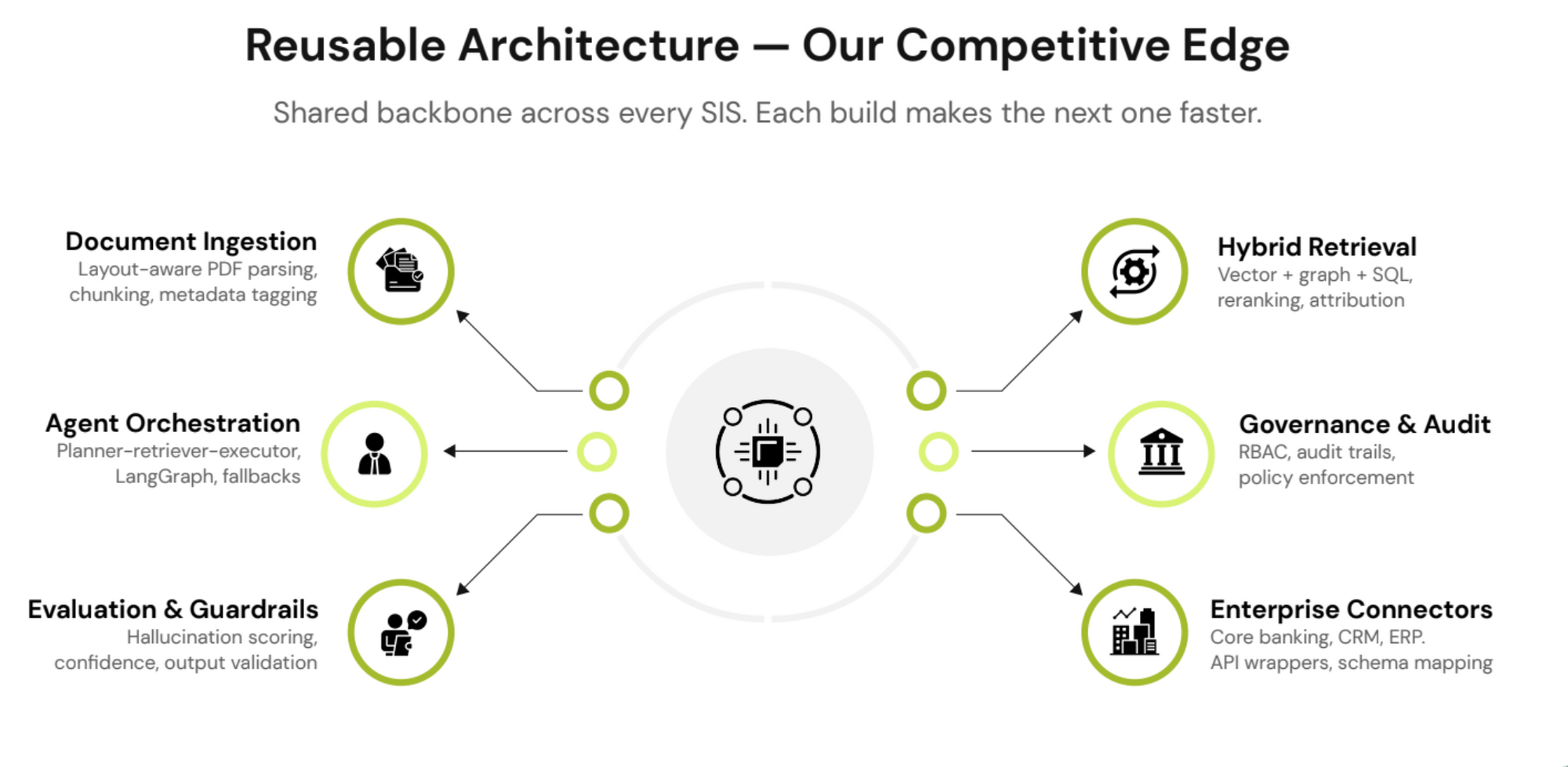
1. Designed for Production from Day One
A Specific Intelligence System only becomes valuable when it operates reliably in real business environments. For that reason, every system includes an infrastructure required for enterprise-scale deployment.
This includes:
- Document Ingestion: Gyde's SIS reads PDFs and complex documents intelligently. Beyond just text extraction, it understands layout, structure, and context.
- Hybrid Retrieval: Gyde's SIS finds the right information using three methods simultaneously (vector search + graph relationships + SQL queries) — more accurate than RAG alone.
- Agent Orchestration: Gyde's SIS has a "brain" that plans, retrieves, and executes with fallback logic if something goes wrong.
- Governance & Audit: Gyde's SIS has role-based access control, full audit trails, policy enforcement (this is what makes it enterprise-safe!)
- Evaluation & Guardrails: Gyde's SIS can lets admins score every output for hallucination risk, confidence levels, and validity before it reaches a user.
- Enterprise Connectors: Gyde's SIS has pre-built connections to core banking, CRM, ERP systems. This removes integration work on every new deployment.
These aren't assembled from scratch for each client. Gyde maintains a shared architecture backbone across every personalized SIS it builds. Six reusable components you see above are carried forward from one deployment to the next.
2. They build it around how your business actually works
Before anything gets built, Gyde maps the specific workflow the system needs to sit inside. That includes:
- internal data sources and formats
- business rules and policies
- regulatory and compliance requirements
- workflow patterns across teams
- exception handling and escalation logic
The system is shaped around all of that. You don't change how you work to fit the AI. The AI fits the way you work.
3. A dedicated five-person team owns it from start to finish
SIS is built and run by a small, focused team Gyde calls an AI POD.
The POD typically includes:
- POD Lead – AI architecture and client collaboration
- Data Engineer – pipelines, data preparation, and integrations
- AI/ML Engineer – models, RAG systems, and prompt orchestration
- Backend Engineer – APIs, services, and infrastructure
- QA / Delivery Lead – testing, quality control, and deployment readiness
Together, the team builds the system architecture that includes input validation, reasoning layers, workflow integrations, and compliance safeguards.
Unlike traditional consulting engagements where teams deliver a solution and move on, this AI POD team monitors the system, catches problems early, and keeps all running to agreed standards. If something drifts, they fix it.
This is what makes the delivery model compound over time. Each new SIS benefits from components that have been already tested in production to solve previous bottlenecks.
Together, these layers ensure the system is built for operational reliability.
Real-World Example: Brand-Safe Email Agent
In regulated industries, customer-facing emails require compliance review before delivery. This creates tension: sales teams need speed, compliance teams need control.
This is the kind of problem a Specific Intelligence System is built for.
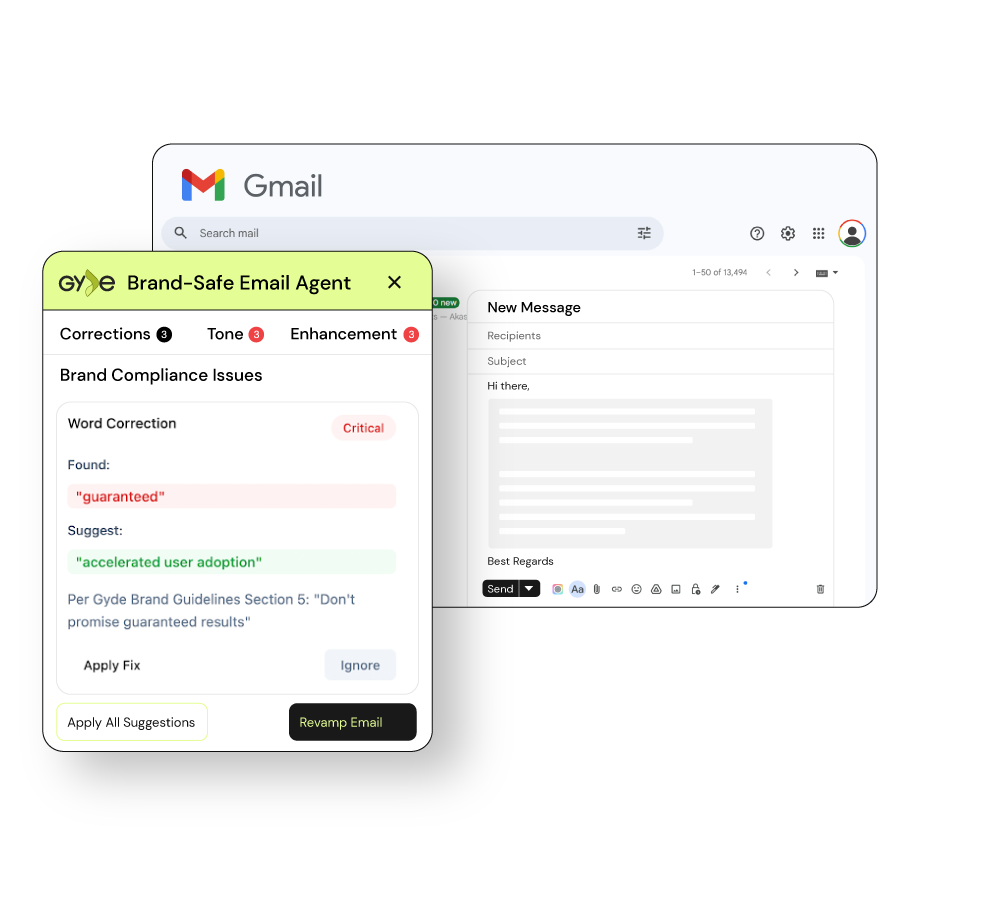
Take a financial services organization, for example. The system (call it brand-safe email agent) sits directly in their email workflow. When a representative drafts a customer email in Gmail, Outlook or their CRM, the SIS automatically reviews the message before send.
The review applies multiple checks:
- Scans for regulatory violations
- Validates against brand guidelines
- Flags prohibited claims or restricted language
- Suggests compliant alternatives with required disclosures
Measurable impact:
- 83% reduction in compliance violations
- 96% faster email review cycles
- 88% reduction in legal review workload
More importantly: communication velocity increased while compliance control strengthened.
Gyde deploys SIS like brand-safe email agent and even more complex SIS as well. Similar architectures power specific problems like:
- Sales roleplay coach: Allows sales reps to practice handle objections and product pitches embedded in their workflow before engaging real prospects.
- Underwriting support: Assists house loan underwriters analyze income proofs, credit reports, and property valuations together to flag policy conflicts and hidden risk signals before approval decisions.
- Document verification: Cross-checks multi-document loan applications (bank statements, salary slips, tax filings, property papers) to detect subtle inconsistencies that manual reviews often miss.
Delivery Models Based on Your AI Maturity
Organizations adopt AI at different stages of maturity. To accommodate this, Gyde offers three delivery models, each aligned with a different start point.
The table below outlines their core definitions, target audiences, and practical applications:
| Aspect | Augment Existing | Build New (360) | Deploy Proven |
|---|---|---|---|
| What it means | Add intelligence to current workflows without rebuilding infrastructure. | Create end-to-end intelligent systems from discovery through deployment. | Implement validated solutions that have already worked in similar environments. |
| Best for | Organizations with established processes that need intelligence enhancement. | Organizations addressing new operational challenges or replacing legacy approaches. | Organizations following proven patterns within their industry. |
| Example use case | Add compliance checking to existing email systems without changing how representatives work. | Build a full underwriting support system integrating risk assessment, document verification, and reviewer assignment. | Deploy a brand-safe communication system using architecture validated in similar regulated environments. |
This structured approach ensures systems reach production.
FINAL NOTE
The enterprise AI graveyard is full of ambitious platforms that promised to do everything and delivered nothing reliable enough to trust. Broad scope, diffuse accountability, and zero governance is a recipe for a failed pilot.
Specific Intelligence Systems flip that equation. By constraining scope to one bottleneck, one workflow, and one measurable outcome, they create the conditions for something most enterprise AI initiatives never achieve: an AI system you can actually ship, audit, and trust.
This is exactly what Gyde is built to deliver. Not a platform to configure on your own, but a complete system designed around your workflows, connected to your data, governed by your rules, and operated by a dedicated team that stays accountable after it goes live.
Every SIS Gyde builds compounds on what came before, which means faster deployment, lower risk, and higher reliability with each new problem solved.
Specific Intelligence Systems won't transform your enterprise overnight. But they might be the most honest answer to the question every leadership team is sitting with right now: how do we get AI out of the pilot stage and into the flow of work?
Start narrow. Build it properly. Own what it does.
FAQs
What are enterprise AI systems?
Answer: Enterprise AI systems are AI solutions designed to operate within business nuances, enterprise software, and organizational data environments. They integrate with systems like CRM, ERP, and internal databases while supporting governance, compliance, and large-scale operational decision-making.
What is the difference between AI agents and Specific Intelligence Systems?
Answer: An AI agent is a single component — it receives a goal, takes a sequence of actions, and produces an output. It can be useful in isolation, but it has no built-in awareness of enterprise rules, data boundaries, or compliance requirements.
A Specific Intelligence System is the complete architecture that makes an agent production-ready. It includes the data pipelines that give the agent the right context, the governance controls that define what it can and cannot do, the monitoring systems that catch when it drifts, and the human oversight mechanisms that keep critical decisions accountable.
The simplest way to think about it: an AI agent is the reasoning engine. An SIS is everything that has to exist around that engine before an enterprise can trust it with a real workflow.
Which platforms help enterprises build Specific Intelligence Systems?
Answer: Gyde builds and operates Specific Intelligence Systems directly inside enterprise workflows through its AI POD delivery model; handling architecture, integration, compliance, and ongoing operations as a managed partnership, not a software license.
Does implementing an SIS require replacing existing systems?
Answer:
- No. An SIS is designed to sit inside workflows that already exist. They don't replace them.
- It connects to current systems like CRM, ERP, or core banking through pre-built integrations, adds an intelligence layer at a specific decision point, and operates without requiring teams to change how they work.
- All such efforts are made to make existing processes more reliable and efficient, at best.
What is the difference between a production-grade AI system and a proof of concept?
Answer:
- A proof of concept (POC) tells us that AI can work under controlled conditions. Most enterprise AI projects get this right with clean data and limited scope.
- However, the gap between a working demo and a system is impacted by live and complex business environment.
- A production-grade system handles messy real-world data, enforces compliance rules on every output, maintains audit trails, integrates with existing enterprise systems, and continues to perform when edge cases appear.
- The distinction isn't about the quality of the AI model — it's about whether everything surrounding the model has been built to enterprise standards.