
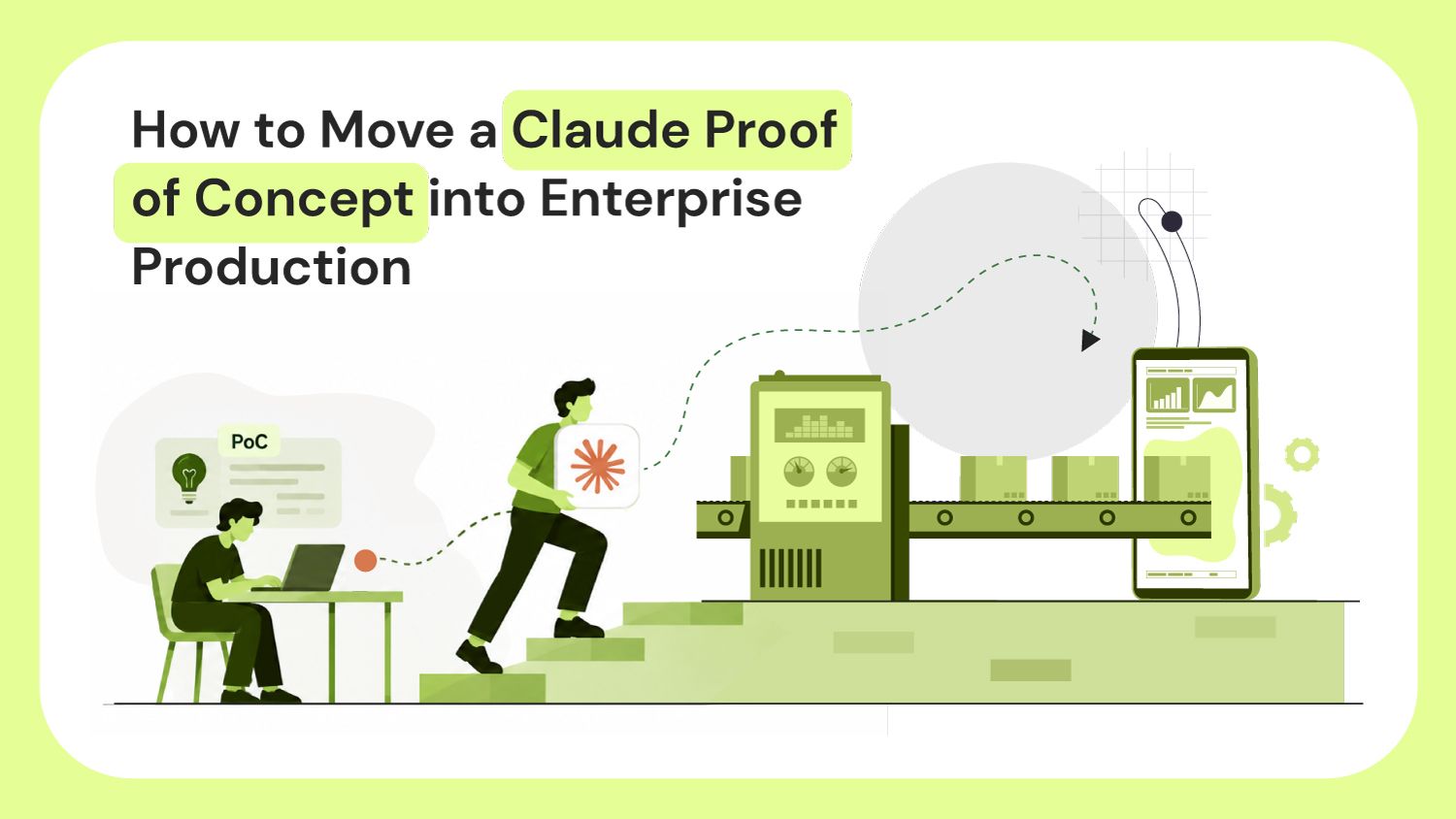
In March 2026, Anthropic launched its $100M Claude Partner Network and explicitly said its partners are instrumental in helping enterprises “from proof of concept to production with Claude.”
That reflects where many enterprise Claude initiatives are today. Teams are testing Claude through proofs of concept, and a successful POC answers an important first question: Can Claude do what we need it to do?
But that is only the first question. Enterprises also need to ask: Can we trust Claude with enterprise data, connect it to our business systems, and put it in front of users without introducing risks we cannot see or control?
This is where many promising Claude initiatives stall.
Claude may perform well in a controlled POC, but production introduces a very different set of requirements: permissions, integrations, evaluation, monitoring, cost controls, failure handling, and clear ownership.
The result is a gap between proving that Claude works and building a production-ready system around it. And for many enterprises, closing that gap is the hardest part of the journey from POC to production.
This becomes especially problematic when enterprises take confidence from one type of Claude POC and applies it to another, without thinking of enterprise production reality.
What Is a Claude POC?
A Claude POC, or proof of concept, is a small-scale project that tests whether Claude can support a specific use case before the organization commits to a full production build.
What Is Enterprise Production?
Enterprise production means preparing that capability to handle higher usage, edge cases, permissions, audits, system integrations, and ongoing monitoring as part of day-to-day operations.
If you are a CIO, CTO, enterprise architect, AI product owner, or security leader responsible for moving a successful Claude pilot into production, this article is designed for the questions you are likely facing now.
Table of Content
- Why a Successful Claude POC May Still Not Be Production-Ready
- What Makes a Claude POC Production-Ready?
- Five Things a Claude Workload Needs Before Production
- Before You Ship: A 7-Question Readiness Check
- Why a Checklist Isn't Enough
- How Gyde Operationalizes Your Claude Proof of Concept
- FAQs
Why a Successful Claude POC May Still Not Be Production-Ready
A Claude workload is the specific task or workflow Claude is being asked to perform, from writing and reviewing code to analyzing contracts, researching accounts, or assisting customer support teams.
That distinction matters because different Claude workloads are tested in very different environments.
Consider two broad categories: coding POCs and knowledge-work POCs.
A coding POC tests Claude within a software development workflow. It may operate against a defined repository and benefit from version control, automated tests, code review, and CI pipelines.
A knowledge-work POC tests Claude against business information and workflows, such as contract review, customer support, financial analysis, or research. Its outputs are often harder to validate automatically. A response can look convincing while still being incomplete, inaccurate, or inconsistent with company policy.
Neither category is inherently safer or more production-ready.
The important point is that success in one type of Claude workload does not establish the evaluation, controls, or operating model required for another.
| Dimension | Coding POC | Knowledge-Work POC |
|---|---|---|
| Inputs | Defined repositories and files | Changing documents, emails, and records |
| Expected output | Often executable or testable | Often requires judgment or policy interpretation |
| Feedback | Tests, CI, and code review | Human review, rubrics, or custom evaluations |
| Failure visibility | Often detected during testing | May remain hidden in a plausible response |
A successful POC proves value in one controlled context. It does not prove that the workload is ready to operate under different data, users, risks, and consequences.
What Makes a Claude POC Production-Ready?
This core distinction explains why a strong Claude POC demo cannot serve as approval for enterprise production; governance is essential during the transition, and Claude workloads cannot be managed under traditional software frameworks.
A POC Proves
Can this technically work?
- Small group of users
- Limited data
- Favorable inputs
- Manual oversight
- Minimal consequences if something goes wrong
Production Must Prove
Can this operate reliably at scale?
- Scale in users
- Messy enterprise data
- Complex integrations
- Repeatable evaluation
- Indicative business consequences
KEY INSIGHT
Enterprise deployment isn't about validating Claude as a general technology, but about governing a specific application's parameters, risk profile, and operational oversight.
A production-ready Claude workload needs at least five things.
Five Things a Claude Workload Needs Before Production
01. Bounded Workload
Define what Claude does, who uses it, what data it can access, where it fits, and how success is measured.
02. Data & Permission Boundaries
Establish clear boundaries around the data and systems the workload can access.
03. Tool & MCP Access
Define what tools Claude can access and how those connections fit into the workflow.
04. Repeatable Evaluation
Test against realistic inputs, difficult cases, and defined success criteria.
05. Named Ownership
Assign responsibility for quality, monitoring, cost, failures, and ongoing changes.
1. Define a Bounded Workload
One of our customers, Accounti, didn't start with "use Claude for investor onboarding." They scoped it down to extracting specific KYC fields from uploaded documents and flagging quality issues for a human to check.
A production workload should clearly define:
- What Claude does
- Who uses it
- What data it can access
- Where it fits into the workflow
- What happens when it is uncertain or wrong
- How success will be measured
That narrow definition is what made the 33% faster onboarding time measurable for Accounti in the first place. A vague scope produces a vague result.
The narrower the initial scope, the easier it is to validate and operate.
How Can Gyde Move Your Claude Workload Into Production?
Bring Gyde a Claude use case that has shown value but is blocked by data access, security approval, evaluation, integration, cost, or ownership.
Learn more about Claude Implementation →2. Establish Explicit Data and Permission Boundaries
POCs often rely on shortcuts.
A team may use an existing login, a shared drive, sample exports, or broad access that is acceptable for experimentation.
Those shortcuts become problems when the system moves toward production.
Production requires clear answers to questions such as:
- What data can Claude access?
- What data can it not access?
- Which users can access the workload?
- What permissions are inherited from existing systems?
- What happens when permissions change?
- How are access and activity audited?
The goal is to simply give Claude access to more context alongside the right information, for the right workflow, under the right permissions.
3. Design Tool and MCP Access Carefully
A self-contained POC can simply process an input and generate an output. Production workloads are often more connected.
Claude may need to retrieve information from internal systems, access live data, update tickets, or trigger downstream workflows through the Model Context Protocol (MCP) or other integrations.
That introduces another layer of risk. Every connection needs to be reviewed for permissions, data exposure, failure handling, authentication, tool misuse, auditability and downstream consequences.
The same discipline applies even when the output never touches another system. Another of our customer, Tossit, using Claude to grade spoken cook assessments, though getting the score right is critical to avoid costly hiring mistakes. It can mark a skilled cook as unqualified, or clear one who isn't ready.
So the design doesn't let Claude's score stand on its own: low-confidence answers route to a human reviewer, who can override any score before it's final.
The same question applies here as it does to any connected system. It's not whether Claude can produce a score. It's what should happen before that score is allowed to count.
4. Build Evaluation That Doesn't Depend on a Demo Audience
This is often the biggest gap between a successful POC and a production-ready workload.
During a demo, the people evaluating Claude already understand what the system is supposed to do. They know how to phrase prompts. They can spot mistakes. They may even unconsciously steer the system toward success. Users won't.
Production evaluation needs to be repeatable.
Instead of asking: “Does this output look good?”
Teams should be able to ask: “Does this workload consistently meet our defined quality threshold across realistic and difficult inputs?”
That means creating:
- Representative test cases
- Edge cases
- Expected behaviors
- Quality thresholds
- Failure criteria
- Regression tests
- A process for updating evaluations as the workload changes
For coding workloads, much of this structure may already exist through testing and CI.
For knowledge-work workloads, it often has to be built from scratch.
5. Assign Named Ownership
In a POC, ownership usually defaults to the person who built it.
That works until the person moves to another project.
Production requires explicit accountability.
At minimum, organizations should identify:
- Business owner: Accountable for business outcomes and workflow performance.
- Technical owner: Responsible for system integrity, integrations, and technical issues.
- Operational process: Defines what happens when performance degrades, users report problems, or requirements change.
Ownership isn't an administrative detail.
AI systems can degrade as data changes, business rules evolve, and new edge cases appear. Without someone accountable for monitoring and maintaining the workload, those problems can remain unnoticed.
Below is a snapshot of the key questions driving each phase as enterprises transition a Claude POC into production:
| Phase | Core Question | What Happens |
|---|---|---|
| Define | What are we building, for whom, and why? | Set the workload boundaries, identify users, define the human role, and agree on measurable success criteria. |
| Design | How will it work safely? | Design the context, permissions, tool access, approval points, and failure-handling process. |
| Evaluate | Does it perform reliably? | Test representative inputs, edge cases, regressions, and performance against defined quality thresholds. |
| Deploy | Can it operate within the enterprise environment? | Integrate enterprise systems, validate controls, plan the rollout, and establish rollback paths. |
| Operate | Is it delivering value sustainably? | Monitor quality, cost, latency, failures, adoption, and changing business requirements. |
Before You Ship: A 7-Question Readiness Check
Before moving a Claude workload into production, ask:
Is there a named business owner?
Not just the person who built the POC.
Are data-access boundaries explicit?
Do you know exactly what the workload can see—and what it cannot?
Has it been tested against failure cases?
Not just the inputs that made the original demo successful.
Have security and compliance reviewed the permissions?
Especially for connected tools, sensitive data, and external-facing workflows.
Is the evaluation repeatable?
Can someone who wasn't present at the original demo run the same evaluation and reach a consistent conclusion?
Is the cost and performance profile understood?
Don't assume pilot economics will remain the same at production volume.
Is monitoring in place?
Can the team detect quality degradation or system failures before users discover them?
If several of these questions remain unanswered, the workload isn't ready—regardless of how impressive the demo looks.
Why (Sometimes) a Checklist Isn't Enough
A checklist tells you what to verify. It doesn't tell you how much risk each item carries.
Consider two workloads that both pass the same readiness checklist:
Contract summarization for internal use
An incorrect summary may require a human to correct it before the document moves forward.
Customer-facing financial guidance
An incorrect output could have regulatory, financial, or reputational consequences.
Both systems may have:
- Data boundaries
- Security approval
- Evaluation
- Monitoring
- Named ownership
But they should not receive the same level of scrutiny.
RISK CHANGES THE STANDARD
Passing the same checklist does not mean two workloads carry the same risk.
Lower Risk
Contract summarization for internal use, where a human can review and correct the output before it moves forward.
Higher Risk
Customer-facing financial guidance, where an incorrect output could create regulatory, financial, or reputational consequences.
The higher the potential impact, the stronger the evaluation, controls, monitoring, and human oversight should be.
This is why production readiness also needs a risk-based approach.
Start by identifying:
- What business process does the workload affect?
- What happens if Claude is wrong?
- What data does it access?
- Who receives the output?
- Can a human intervene?
- Could an error create legal, regulatory, financial, or reputational consequences?
The higher the potential impact, the stronger the evaluation, controls, monitoring, and human oversight should be.
How Gyde Operationalizes Your Claude Proof of Concept (POC)
Gyde is a registered Anthropic partner helping enterprises take defined Claude workloads from POC to production.
Our team includes Claude-certified practitioners and has partner access to Anthropic’s product roadmap and model developments. That gives our delivery teams deeper context as they make architecture, evaluation, governance, and deployment decisions around Claude.
But getting Claude into production requires more than model expertise.
A successful POC may prove that Claude can perform the task. Production requires the system around Claude to work too: enterprise context, tool access, permissions, integrations, evaluations, exception handling, monitoring, and clear operational ownership.
That is the layer Gyde builds.
We deploy AI Delivery PODs around a defined Claude workload. Each POD brings together AI engineering, product, governance, and deployment expertise to turn the POC into an operational specific intelligence systems (SIS).
The Five Phases from Claude POC to Production
Define
Set the production boundary around one business workload. Define what Claude should do, what stays with humans, the systems involved, and the measurable outcomes required for release.
Design
Design the context, prompts, permissions, tool access, integrations, and MCP connections around the actual enterprise workflow.
Evaluate
Build repeatable evaluations using representative enterprise scenarios, edge cases, failure conditions, and permission boundaries to establish whether the workload is ready for release.
Deploy
Connect Claude to the enterprise systems and data required to perform the workload, with the appropriate access controls, guardrails, and release controls in place.
Operate
Put monitoring, ownership, escalation paths, change controls, and operating procedures in place so your team can run and improve the workload after deployment.
With Gyde, your enterprise can fulfill the goal to make a POC work and make the resulting system usable, governable, measurable, and sustainable in production.

FAQs
1. What is the difference between a Claude POC and a production-ready Claude workload?
A Claude proof of concept (POC) demonstrates that Claude can solve a specific problem under controlled conditions. A production-ready workload must go further by operating reliably with users, data, defined permissions, repeatable evaluation, monitoring, and clear ownership.
In short, a POC proves feasibility. Production proves reliability, control, and sustainability at scale.
2. Is a Claude coding POC easier to productionize than other Claude use cases?
It can be, because coding environments often have built-in evaluation mechanisms such as version control, unit tests, CI pipelines, and clearly bounded repositories.
Other workloads, such as contract summarization or customer support, may use changing and unstructured data without an automated way to determine whether an output is correct.
That doesn't mean coding POCs are automatically production-ready. It means their evaluation process may already be more structured.
3. How should enterprises evaluate Claude's output before production?
Evaluation should go beyond reviewing a few successful demo outputs.
Teams should create repeatable tests using realistic data, difficult inputs, edge cases, and defined quality thresholds. The evaluation should be documented well enough that someone who was not involved in the original POC can run it and understand whether the workload meets the required standard.
For knowledge-work use cases, building this evaluation process is often one of the most important steps between a successful POC and production.
4. What role does MCP play when moving Claude into production?
MCP and other integrations can allow Claude to interact with enterprise data and tools rather than operating as a standalone assistant.
That makes production architecture more powerful, but it also introduces additional considerations around permissions, data access, authentication, tool misuse, failure handling, and auditability.
The key question is not simply whether Claude can access a system, but what Claude should be allowed to do once connected.
5. What should happen after a Claude workload goes into production?
Production should not be treated as the end of the project.
Teams should continue monitoring output quality, performance, cost, usage, failures, and changes in the underlying workflow or data. There should also be a named business owner and technical owner responsible for addressing issues and updating the workload as requirements change.
A Claude workload is truly production-ready when the organization has a plan not only to launch it, but to operate and improve it over time.