
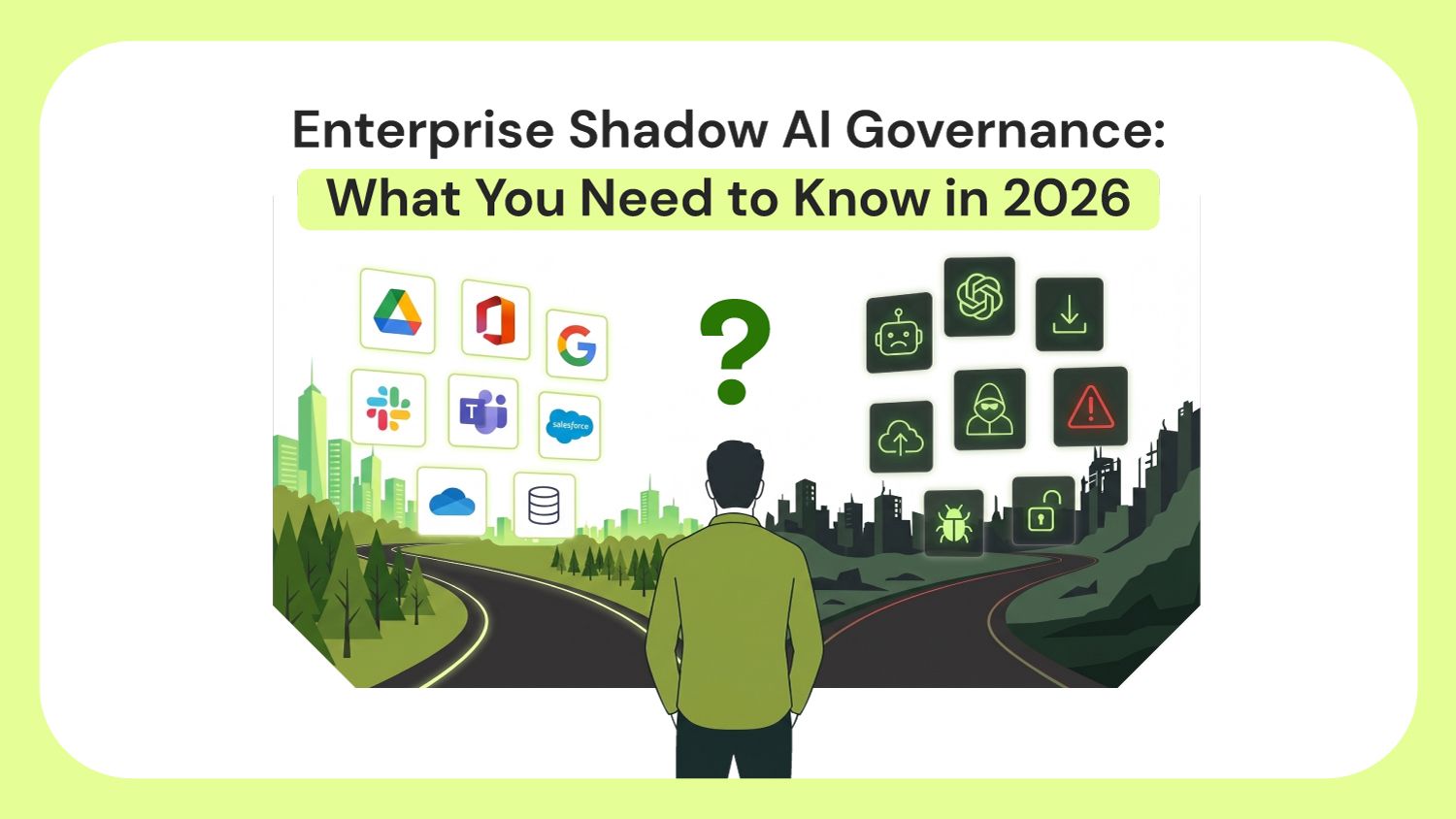
Samsung found its engineers had pasted proprietary source code into ChatGPT to accelerate their debugging work.
The code likely entered the model's training pipeline before the company knew the breach had occurred. Samsung responded by restricting access to generative AI, but the incident exposed a larger problem: employees often adopt AI tools long before governance catches up.
The numbers tell a similar story across industries:
Today, one of the biggest enterprise AI challenges is the lack of visibility into which AI tools employees are using, what data is being shared, and whether those interactions comply with security and regulatory policies. By the time IT or security teams discover shadow AI, the exposure may have already occurred.
If you're a CISO, CTO, or Head of Compliance at a BFSI or enterprise organization, your employees are likely already using AI tools you haven't approved.
This blog explains what shadow AI looks like in practice, why traditional IT governance often fails to detect it, and how to build an AI governance model that enables innovation without compromising security or compliance.
Table of Contents
- What Is Shadow AI?
- What Is The Difference Between Shadow IT and Shadow AI?
- Why Employees Use Unapproved AI Tools?
- Why Enterprises Can't Ban Their Way Out of BYOAI?
- What Effective Shadow AI Governance Looks Like
- How Gyde Helps Enterprises Govern AI Safely
- FAQs
What Is Shadow AI?
Shadow AI refers to the use of artificial intelligence tools like chatbots, code assistants, document summarizers, AI-enhanced SaaS features by employees without the knowledge, formal approval, or oversight of IT or compliance teams.
Shadow AI isn't created by malicious employees. It emerges when the need for faster work outpaces an organization's ability to provide governed AI tools.
Across enterprises in BFSI, healthcare, and technology, that governance gap has become one of the defining AI challenges.
Difference between Shadow IT and Shadow AI
| Dimension | Shadow IT | Shadow AI |
|---|---|---|
| Definition | Employees use unapproved software, SaaS applications, or cloud services. | Employees use unapproved AI tools or AI assistants to complete work tasks. |
| Primary purpose | Improve productivity, collaboration, or file sharing. | Generate content, analyze information, automate work, and support decision-making. |
| How data is handled | Stores or transfers business data. | Processes, interprets, and may retain prompts containing sensitive enterprise data. |
| Risk level | Security gaps, duplicate software, and increased IT costs. | Data leakage, IP exposure, regulatory violations, and AI governance risks. |
| Example | Using an unauthorized project management or file-sharing platform. | Uploading customer records or proprietary code into ChatGPT or another AI assistant. |
| Business impact | Operational inefficiency and unmanaged software spend. | Security incidents, compliance failures, and reputational damage. |
| Governance focus | IT asset management, software approvals, and access control. | AI governance, data protection, model usage policies, and regulatory compliance. |
| Typical owner | IT operations and procurement teams. | IT, Security, Risk, Compliance, and AI Governance teams. |
| Long-term concern | Unmanaged software sprawl and rising operational costs. | Uncontrolled AI adoption, sensitive data exposure, and loss of enterprise trust. |
Why Employees Use Unapproved AI Tools?
The reasons employees default to shadow AI are not difficult to understand. Let's look at it in depth:
A. Productivity and speed gains
- AI tools often produce drafts, summaries, code snippets, or data analysis far faster than manual work, so employees adopt them to meet deadlines and increase throughput.
- When approved tooling is slow, limited, or requires lengthy procurement/IT steps, turning to an immediately available public AI service is a pragmatic shortcut.
B. Perceived career/skill benefits
- Many workers believe mastering generative AI will make them more marketable, increase job satisfaction, and lead to higher pay, which motivates experimentation outside official channels.
- Using AI is seen as a way to upskill quickly and deliver higher-impact outputs, creating personal incentives to bypass restrictive policies.
C. Gaps in policy, tools, and training
- A large share of workplaces lack clear, communicated AI policies or do not provide tools that meet employees’ needs, so workers feel forced to self-serve.
- Many employees haven’t received formal training on safe/ethical AI use, so they either don’t recognize risks or believe they can manage them themselves.
D. Managerial and peer normalization
- In many organizations, direct managers or senior leaders themselves use unapproved AI tools; managerial awareness or tacit approval normalizes the behavior.
- When colleagues openly share AI-generated work, that social proof reduces friction for others to adopt the same tools.
E. Feature and capability mismatch
- Approved enterprise tools sometimes lack the latest models, integrations, or ease-of-use found in public tools, so employees choose the solution that best fits the task.
- Specific features (e.g., better code completion, higher-quality writing prompts, or multimodal outputs) can be decisive for time-sensitive work.
Why Enterprises Can't Ban Their Way Out of BYOAI
Blocking AI is an action or a policy decision made by IT/Security teams (e.g., blocking ChatGPT on the corporate network or banning AI extensions).
BYOAI (Bring Your Own AI) is a behavior driven by employees who bring unauthorized AI tools into the workplace to get their jobs done faster.
Blocking AI (the action) actually accelerates BYOAI (the behavior).
When an organization tries to completely ban or block mainstream AI tools, it doesn't actually stop the employee's desire for productivity. Instead, it pushes them to find workarounds. They start using personal devices, unapproved browser extensions, or subtle AI features already baked into everyday apps.
How Enterprises Can Reduce Shadow AI Risks
AI Is Already Embedded in Approved Software
Employees can access AI features in trusted tools like Microsoft Teams or Google Workspace, creating governance risks without installing unauthorized software.
Policies Need Technical Enforcement
Usage policies and employee training rely on people making the right choice every time, but they provide no way to verify or enforce compliant behavior.
Embed Governance Into Business Workflows
Instead of depending on individual discretion, embed security, approvals, and compliance checks directly into business processes so they happen automatically.
Provide Governed AI Alternatives
Deploy purpose-built AI for specific business tasks so employees get the productivity they want while the organization retains security, compliance, and oversight.
What Effective Shadow AI Governance Looks Like
Effective shadow AI governance is not achieved through policies alone.
The most successful organizations combine technical controls that operate automatically with organization-wide governance processes that provide visibility, accountability, and oversight.
1/ One Governed AI Workspace
Instead of employees choosing between multiple public AI tools, organizations provide a single governed AI workspace. IT determines which AI models employees can access, what enterprise data those models can use, and how prompts are processed. This gives employees an approved AI experience without sacrificing security or compliance.
2/ Built-in Guardrails
Governance should happen before information ever reaches the model. Built-in controls automatically:
- Filter prohibited or unsafe prompts
- Detect and mask sensitive information such as PII, financial records, and customer data
- Enforce access permissions based on user roles
- Validate AI outputs against organizational policies
These controls reduce the risk of accidental data exposure without relying on employees to make the right decision every time.
3/ Complete AI Observability
Every prompt, response, policy decision, and system action should be logged automatically. This creates a complete audit trail for compliance, investigations, and regulatory reporting while helping security teams understand how AI is being used across the organization.
Technical controls reduce human error, but governance cannot stop at the AI interface. Organizations also need visibility into where AI is being used and provide employees with secure alternatives that fit naturally into their daily work.
4/ Discover Shadow AI Across the Enterprise
You cannot govern what you cannot see. Organizations need continuous discovery of AI usage across browsers, SaaS applications, browser extensions, and employee devices to understand where unapproved AI tools are entering the environment.
5/ Provide Governed AI Alternatives
Blocking public AI tools without providing an enterprise-ready alternative simply encourages workarounds.
Instead of forcing employees to choose between productivity and compliance, organizations should provide AI systems that operate within their own environment, connect to approved enterprise data, and enforce governance automatically.
When the compliant option is also the most useful one, shadow AI adoption naturally declines.
How Gyde Helps Enterprises Govern AI Safely
The governance framework described above is sound. The harder problem is building it. Most enterprises attempting to address shadow AI end up with one of two outcomes: a policy document that employees ignore, or a blanket restriction that pushes AI usage to personal devices.
Neither solves the underlying problem, which is that employees are using general-purpose AI tools because no governed, purpose-built alternative exists for their specific job.
That is the gap Gyde addresses.
Gyde builds Specific Intelligence Systems, AI built for a defined business function, embedded directly into your workflows, and governed within your own environment. An AI system designed for that job, with the access controls, compliance enforcement, and audit trail built in from the start.
Underwriter pastes customer financials into ChatGPT
Income documents, bank statements, and identity data are processed by a public AI model that the organization cannot fully audit, control, or verify.
AI built for underwriting, governed inside your environment
The system retrieves approved internal data, applies the organization's underwriting rules, and generates a structured recommendation. Customer data never leaves the enterprise, and every action is logged for auditability.
For CISOs and compliance leaders, the key question isn't what AI can do. It's what it can access. Gyde logs every prompt, document, and system action from the first interaction, creating a complete audit trail.
For a CTO or Head of AI thinking about production deployment, the question is whether the same controls apply to the thousandth query as they did to the first. Every Gyde system is built with security, compliance, and human-in-the-loop controls at the architecture level, so governance does not degrade as usage scales.
For Operational Risk Teams in Regulated Industries, the challenges with shadow AI appear when on-field teams move sensitive data outside systems the organization controls. Gyde connects directly to the platforms these teams already use, core banking systems, CRMs, ERPs, so the work stays inside the governed environment instead of routing around it.
Once those governed integrations are in place, organizations can deploy additional AI systems for new departments and workflows without rebuilding security and governance from scratch. The same enterprise foundation can support AI across finance, operations, customer service, compliance, HR, and beyond.
That is how you reduce shadow AI in practice: not by banning the behavior, but by removing the reason for it.
FAQs
1. How do you detect shadow AI usage in an organization?
Most enterprises rely on network traffic analysis, browser extension monitoring, DNS/proxy logs, and endpoint DLP tools to flag unsanctioned AI domains. Employee surveys and IT ticket audits also surface tools that technical monitoring misses.
2. Can shadow AI usage violate data privacy regulations like GDPR or DPDP?
Yes. Pasting personal or customer data into public AI tools can constitute an unauthorized data transfer to a third party, which may breach GDPR, India's DPDP Act, or sector-specific rules like RBI's data localization guidelines.
3. Which AI tools are most commonly used as shadow AI in enterprises?
ChatGPT, Gemini, and Claude's consumer apps, along with AI features embedded in tools like Grammarly, Otter.ai, and Notion, are frequently used without formal IT approval.
4. Who is responsible if an employee leaks data through shadow AI?
Liability typically falls on the organization, not the individual employee, since data protection regulations hold companies accountable for how customer and employee data is handled, regardless of which tool caused the exposure.
5. How is shadow AI different in banks versus tech companies?
Banks and NBFCs face stricter regulatory exposure since customer financial data (PII, account details, credit history) is often what gets pasted into unapproved tools, triggering RBI or sector-specific compliance obligations that tech companies don't face in the same way.