
If you clicked on this blog, you’re probably here for one of three reasons:
- You’re comparing DAPs before buying
- You’re exploring Whatfix alternatives
- You want something more flexible or affordable
At their core, both Gyde and Whatfix do the same job. They guide users through tasks within your application with features like step-by-step walkthroughs and in-app help.
What’s changed in recent years, however, is the role of AI in digital adoption.
As software stacks grow more complex and processes change faster, digital adoption tools are no longer just about "walkthroughs". AI is increasingly being used to reduce manual effort, speed up content creation, and make in-app assistance more contextual and responsive.
By looking at how each platform leverages AI, along with differences in pricing, speed to value, and in-app experience, you’ll get a clear sense of which solution best fits your needs.
Here's all that's covered:
- What is Gyde?
- What is Whatfix?
- Quick Comparison Table
- Feature Deep-Dive
- Implementation, Integrations & Time-to-Value
- Pricing & ROI
- Pros & Cons
- Gyde and Whatfix in Customer Use
- How to Choose Between Gyde and Whatfix: 7 Key Questions to Ask
- Final Recommendation
- FAQs
TL;DR — Who should consider which
Whatfix = heavyweight, feature-rich, process-heavy → great for enterprises with deep budgets and long implementation cycles.
Gyde = agile, fast-to-deploy, modern AI-powered → works for both fast-scaling companies and enterprises that want faster ROI without the complexity overhead.
A. What is Gyde?
Gyde is an AI-powered digital adoption platform (DAP) that helps teams and users across Salesforce, SAP, and other enterprise or home-grown system to reduce support tickets, improve data quality, and shorten onboarding & software learning curve.

From end-users perspective, Gyde adapts to how end-users want to learn. For example, when a sales rep needs help creating a contact in Salesforce, they can choose how they want guidance:
- Guide me to a full step-by-step walkthrough
- Assist me to help with only specific steps , without replaying the entire walkthrough—ideal for experienced users
- Watch to view a short, in-app video tutorial without leaving Salesforce
- Read to refer to a screenshot-based guide they can skim at their own pace
All support is available in multiple languages, making Gyde easy to scale across distributed and global teams.
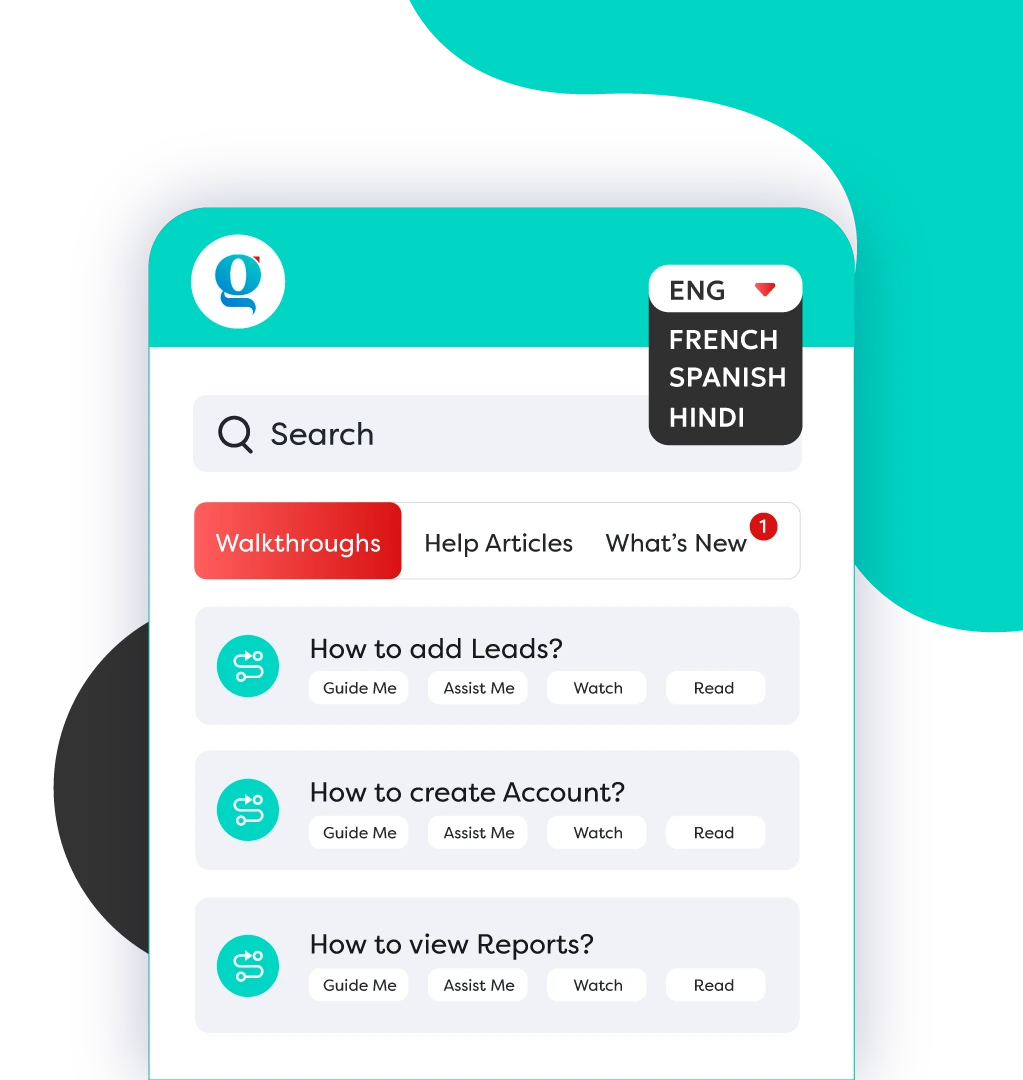
- To keep help easy to discover, Gyde also lets teams organize walkthroughs and help articles into clear categories. From the Gyde icon(appear on bottom right) inside the app, users can quickly browse relevant guidance instead of searching blindly.
- With field validation, Gyde checks what users enter into forms or text fields against predefined rules. So if a sales rep enters incorrect data while creating a contact, Gyde flags it instantly, curbing poor data quality within applications.
(From a training or ops team’s perspective, we’ve further covered Gyde’s authoring and content creation capabilities in detail.)
B. What is Whatfix?
Whatfix is a digital adoption platform that offers teams to create no-code in-app guidance, onboarding tours, and self-service support.
For typical users dealing with enterprise software, Whatfix provides standard in-app assistance through overlays like flows, tooltips, and self-help options, which can help with navigation in tools like Salesforce or SAP.
Whatfix Mirror's sandbox simulation helps enterprises in end-user training by letting the user practice workflows within a replica of an app (risk-free with no fear of breaking anything).
Whatfix’s product suite explicitly includes a Product Analytics module (a no-code event tracking and analysis tool) for measuring how users engage with applications and flows.
In practice, this means large organisations can see not just whether guidance exists, but how it’s actually being used. Teams can track which flows are started or completed, where users drop off, which features are ignored, and how behaviour changes after training or a product update.
C. Gyde vs Whatfix: Quick Comparison Table
Take a look to get an overview of Gyde vs Whatfix in minutes:
| Decision Lens | Gyde | Whatfix |
|---|---|---|
| What it’s built for | AI-led creation of walkthroughs, videos, and in-app guidance | Structured digital adoption with deep product analytics |
| How content is created | AI Record Workflow → Polish lightly → Publish | Design Workflow → Configure/Set Rules → Test → Publish |
| Speed to value | Supports fast rollouts and digital change management | Needs upfront design, planning, and setup |
| Analytics focus | Useful adoption signals like usage trends, step drop-offs, completion insights | Advanced product analytics: funnels, cohorts, event tracking |
| Best suited for | Teams looking for agility, affordability, and quick adoption wins | Teams prioritizing deep product usage analytics |
| Pricing philosophy | Premium AI capabilities without heavy enterprise overhead | Custom enterprise pricing, typically higher annual commitments |
| Top Customers | Bajaj Finance, Verizon, Fidelity | Experian, ACFS Port Logistics, Sentry |
| Verdict | AI-powered digital adoption solution built for application users to learn in the flow of work. | Feature-rich DAP with powerful analytics but heavier setup cost |
D. Gyde vs Whatfix Feature Comparison (In-Depth Analysis)
1/ Authoring & Content creation
This feature lets teams create in-app guidance, so users can complete tasks correctly without leaving the application.
For example, when onboarding a new sales rep to create a Salesforce opportunity, teams can build guidance that walks the rep through every step seamlessly.
In Gyde
- Perform the workflow once; Gyde’s AI captures every click and generates step titles and descriptions automatically.
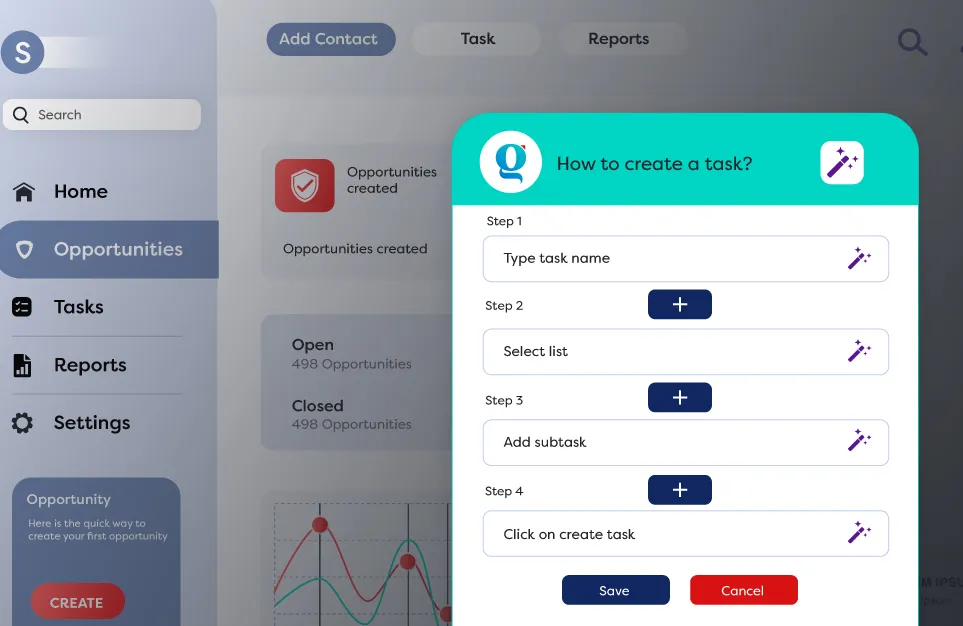
- You can edit text in a step and press record and audio instructions are auto-generated.
- The workflow captured instantly becomes an annotated screenshot guide, timestamped video, and even auto-generates assessment in real-time.
- From dashboard, you can restrict access by role, department, or location. For example, you could make a new Salesforce opportunity workflow visible only to the latest batch of sales reps.
Side note: Updating content or adding steps is intentionally frictionless. Gyde also nudges creators toward best practices (like keeping walkthroughs to 15–20 steps) so guidance stays helpful instead of overwhelming.
In Whatfix
- Authors use Studio to manually capture and organize each step of the process.
- Each field entry, dropdown selection, and button click must be recorded and annotated individually.
- Creators can add pop-ups, Smart Tips, or tooltips along the way, and apply custom styling if needed.
- AI enhancements can assist with minor tasks like generating pop-up suggestions or formatting, but the core workflow capture and step-by-step guidance still requires hands-on training.
Takeaway:
Gyde automates workflow capture and content generation, making creation fast and low-maintenance. Whatfix is flexible and controlled but more manual and time-consuming.
2. AI Deployment & Capabilities
AI has been the big headline ever since Gen AI captured everyone’s imagination, and both Gyde and Whatfix are riding this wave of innovation. Let's see how.
In Gyde
The AI built into Gyde is intentionally practical. The goal is to reduce effort, shorten rollout timelines, and make enablement scalable without heavy production overhead.
You’ve already seen how Gyde’s AI Walkthrough Creator lets training teams (or really anyone) click through a workflow once and instantly generate step-by-step guides, videos, and multilingual versions in minutes.
But Gyde offerings have expanded.
- They now also offers ready-to-use AI agents and apps for specific business workflows.
- These come pre-built for financial services and other domains, helping teams act smarter and not get stuck in AI transformation.
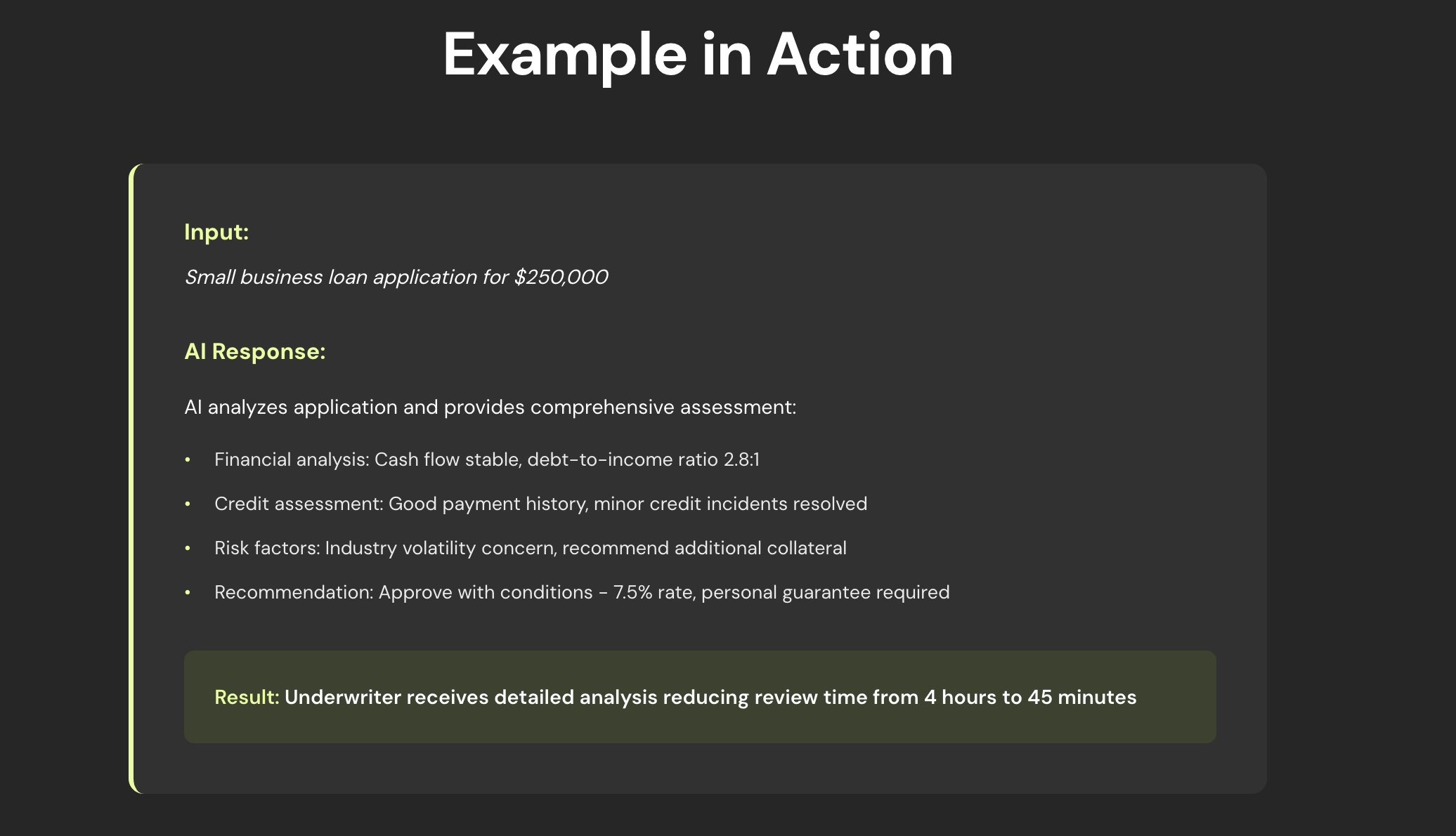
- For example, Gyde’s Loan Underwriting Co-Pilot works in the flow of underwriting; guiding users as they review loan applications by automatically extracting financial data, highlighting risk indicators, and presenting clear recommendations without requiring them to switch systems or run manual checks.
In Whatfix
AI is built from a platform-wide, agent-driven perspective. The idea is to enhance multiple layers of the platform simultaneously. Its AI suite includes:
- Authoring Agent: Helps content creators by suggesting text, formatting, and pop-up enhancements during walkthrough creation.
- Guidance Agent: Personalizes in-app coaching in real time. Based on user actions, it can trigger context-specific flows or recommend additional resources.
- Insights Agent: Analyzes user behavior, feature adoption, and workflow completion across the application.
They all work alongside the ScreenSense engine and large language models (LLMs).
Takeaway:
Essentially, Gyde emphasizes speed, ease, and embedded intelligence, while Whatfix emphasizes depth, automation, and platform-wide insights; both powerful, but suited to slightly different priorities.
3/ Analytics & Measurement
Both platforms offer granular-level analytics to help you understand what exactly the users are engaging with. The difference lies in what each platform chooses to measure most deeply.
In Gyde
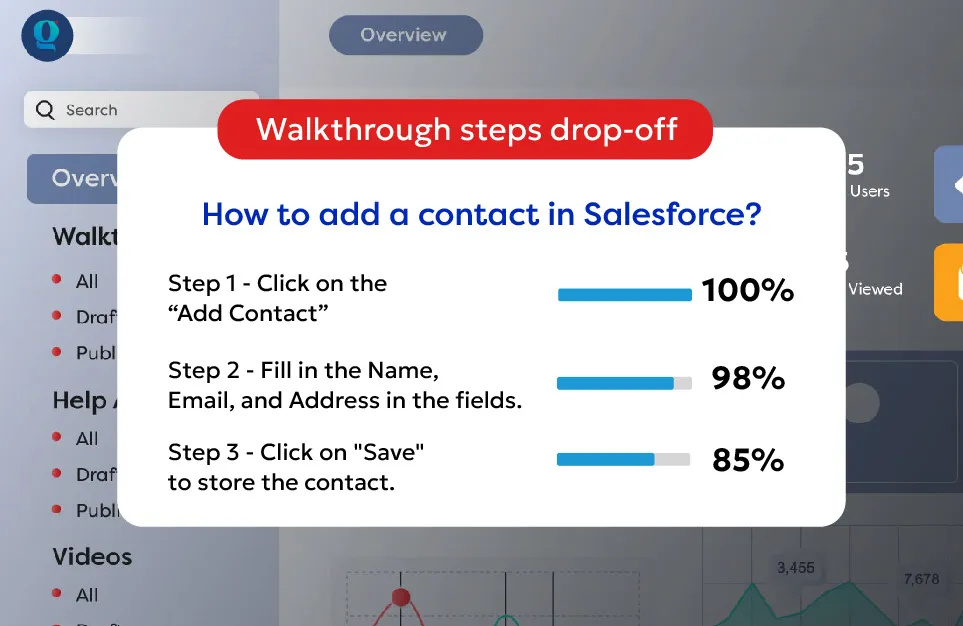
Focusing on adoption and usage metrics that show how well your content is performing for the users. You get a clear view of:
- how many users watched or completed a walkthrough,
- how they interacted with videos and guides,
- where they slowed down or struggled, and
- whether the guidance actually helped them complete the task faster.
It’s a simple way to track training effectiveness and content relevance, especially when you just want to know, “Is this helping users get things done?”
In Whatfix
Whatfix takes analytics a step deeper with product-level insights like funnels, cohorts, and no-code event tracking. This allows teams to analyze full user journeys and understand behavior across specific features or workflows.
You can track:
- how many queries came through Self Help,
- how many users completed Flows or Tasks,
- engagement with Pop-ups, Smart Tips, Beacons, and other widgets,
- and the total number of unique users interacting with Whatfix content.
Takeaway:
Gyde gives you fast, actionable adoption metrics to improve user enablement, while Whatfix provides rich behavioral insights for deeper product & training analysis. Both approaches are valuable; it just depends on whether your focus is immediate usability or in-depth analytics.
4/ Security, Governance & Scale
Both platforms meet enterprise-grade security standards, but they’re optimized for slightly different operating styles.
In Gyde
- Gyde balances strong security with speed and agility. It is SOC 2 Type II, ISO 27001, GDPR, and CCPA certified, ensuring compliance for highly regulated industries.
- Setup is fast, scaling is easy, and administration remains flexible without heavy IT involvement.
- Enterprises in highly regulated and security-sensitive sectors, including financial services leaders like Bajaj Finserv and Muthoot Fincorp, trust Gyde to guide users through critical workflows securely, without slowing down execution.
In Whatfix
- Whatfix is well-established in large enterprises and brings robust governance features like granular access controls, structured digital change management, and compliance alignment.
- It's a strong fit for organizations running global deployments along with layered approval processes.
Takeaway:
Gyde combines security, agility, and trust, showing that even highly regulated customers can adopt it quickly. Whatfix delivers governance and control at scale, suiting organizations that prioritize structured, multi-layered deployment frameworks.
5/ Mobile Support
Both platforms extend digital adoption to mobile, but the way they approach enablement is slightly different.
In Gyde
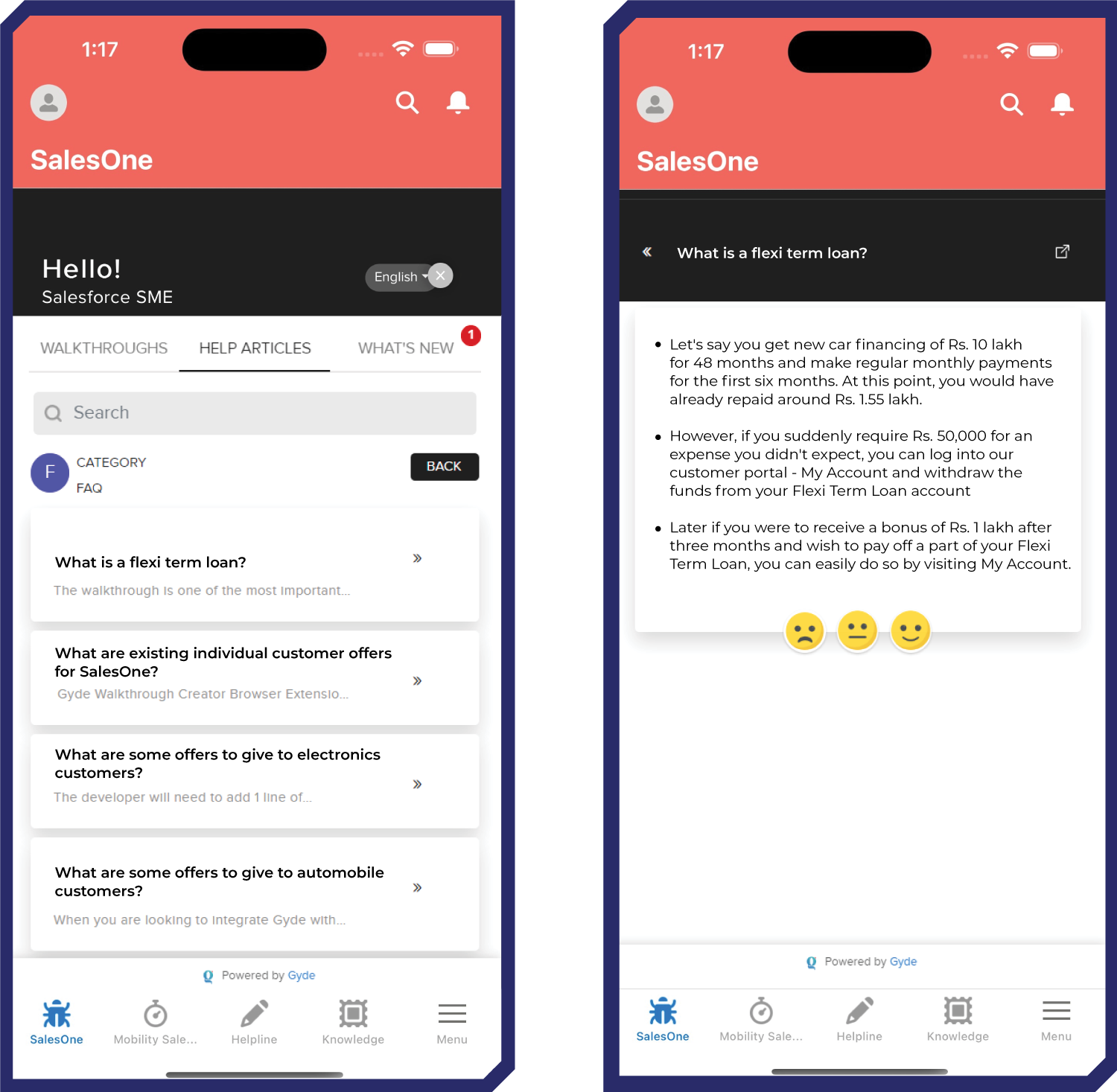
- Gyde keeps mobile training easy. You can record a workflow on your laptop, and it automatically converts it into a mobile-friendly walkthrough, short video, or help article and in multiple languages.
- Alternatively, For users who don’t want step-by-step walkthroughs, Gyde also provides voice instructions in the user’s preferred language.
- For example, a field sales rep verifying a home loan applicant can receive real-time voice guidance for each required field, helping them complete tasks efficiently without switching between devices or screens.
In Whatfix
- Whatfix offers a more mobile-first creation environment through its Mobile Studio and SDK (software development kit).
- For example, if your company has a custom CRM, adding Whatfix via the SDK lets your users get walkthroughs and guidance inside that CRM without needing to redesign the software.
- It enables branded, app-native experiences with no-code editing, real-time content updates, and advanced capabilities like targeting, personalization, and translation across 80+ languages.
Takeaway:
Gyde emphasizes simplicity and quick access for mobile users, while Whatfix focuses on customization for mobile experiences.
E. Implementation, Integrations & Time-to-Value
Both Gyde and Whatfix support enterprise-scale deployments. They both work across web, desktop, and select mobile environments and support essential enterprise needs like SSO, LMS integrations, and analytics exports. But is their time-to-value same? Let's see:
In Gyde
- Gyde is a plug-and-play solution; it can be configured quickly within web-based applications to deliver in-app guidance exactly where users need it. It's built for speed and simplicity.
- Smoothly layer it over your enterprise tools that teams use every day, especially CRMs and ERPs like Salesforce, SAP, and Workday.
- The focus is on making sure guidance feels natural inside these workflows, without extra setup or complexity.
- For example, Bajaj Finance (one of India’s largest and most trusted financial services companies) went live with Gyde in just one month.
- Several other clients have seen similar timelines, showing how Gyde is a strong fit for organizations that need fast enablement during new feature rollouts.
In Whatfix
- Whatfix offers a integration ecosystem with more prebuilt connectors and deeper configuration options.
- That's mostly the reason Whatfix implementations tend to take longer, especially when teams add deep analytics, granular governance, or large-scale multilingual content.
- The upside is that this structure brings more advanced measurement and managed implementation support. This is ideal for mature digital adoption programs with complex workflows.
F. Gyde vs Whatfix Pricing & ROI: What to Expect
Both Gyde and Whatfix offer custom pricing based on apps, MAUs, and feature requirements but the buying experience and cost profile differ quite a bit.
In Gyde
- Gyde makes it easy to get started. Teams can request a demo and get customized pricing, which helps them experiment, validate impact, and scale gradually.
- Shorter implementation cycles also mean faster time-to-value which makes it a good fit for teams that want results quickly without a long procurement process.
- By procurement, we mean the internal buying process: approvals, security checks, legal review, budgeting, IT alignment, pilot setup, etc. For some companies, this is quick. For larger enterprises, it can be months. So choose a platform like Gyde can fit perfectly if you're on a purchasing deadline.
In Whatfix
- Whatfix typically operates in the higher pricing bracket. Since they’re a large global player with professional services, governance layers, and managed rollouts, the cost is naturally higher.
- Expect demos, scoping calls, and formal proposal stages (all thorough), but with a longer pricing + implementation turnaround—user reviews often cite 1–4 months for full rollout, which can delay ROI and add opportunity costs like $15,000 in lost productivity for pricier setups.
G. Gyde vs Whatfix: Pros and Cons
Gyde
Pros
- AI-powered workflow capture: creates guides, videos, and assessments instantly.
- Multiple learning formats: full walkthroughs, assist mode, field validation, videos, screenshot guides, multilingual voice instructions.
- Quick deployment: plug-and-play setup; fast time-to-value.
- Mobile-ready: automatic mobile-friendly guidance and voice instructions for field teams.
- Enterprise-grade security: SOC 2, ISO 27001, GDPR, CCPA; trusted by top financial and regulatory clients.
- Ready-to-use AI agents: pre-built solutions for common workflows (e.g., email compliance, KYC, loan verification).
Cons:
- Analytics focus is basic adoption metrics; less granular than Whatfix.
- Cannot be configured on desktop apps
Whatfix
Pros:
- Flexible authoring: manual control with pop-ups, Smart Tips, and custom styling.
- Advanced AI agents: assist in authoring, in-app guidance, and behavioral insights.
- Deep analytics: funnels, cohorts, and event tracking for product-level insights.
- Strong governance: granular access controls, structured rollout management, compliance-ready.
- Customizable mobile experiences: branded, app-native, multilingual, with targeting and personalization.
- Rich integration ecosystem for complex tech stacks.
Cons:
- Manual workflow capture is time-consuming despite AI support.
- Longer implementation cycles due to advanced configuration and governance.
- Higher cost and enterprise-focused pricing.
- Steeper learning curve for content creators and admins.
H. Customer Stories: Gyde vs Whatfix in Action
We’re comparing these two customer stories to move past feature checklists and show how Gyde and Whatfix drive adoption in real-world workflows:
| Outcome | Bajaj Finance – Gyde | Acorn Recruitment – Whatfix |
|---|---|---|
| Industry & Users | Financial services; 50,000+ employees | Recruitment; 200 employees |
| Primary Challenge | Field agents struggled with Salesforce workflows, leading to delays in loan processing | Long recruiter onboarding cycles and compliance issues within ATS workflows |
| Solution Approach | AI-powered walkthroughs, voice guidance, contextual help, and short videos across desktop & mobile. No-code creator auto-generates guides and videos. | Role-based in-app guidance using Flows, Task Lists, Pop-Ups, and Self Help. Sandbox simulation for safe practice in Bullhorn ATS. |
| Time to Value | Live within 1 month | Not publicly disclosed |
| Measured Impact | Loan file holds reduced from 18% to 9.7% in 3 months. 67% reduction in time spent on training. | Reduction in training-related queries and improved knowledge retention |
| Verdict | Demonstrates fast, large-scale impact where speed, field adoption, and measurable outcomes matter | Effective for structured onboarding but with less emphasis on rapid deployment or quantified ROI |
I. Gyde vs Whatfix: 7 Demo Questions You Should Ask (And Quick Answers From Gyde)
When you're evaluating DAP platforms like Gyde and Whatfix, the demo is where clarity happens. Seeing your workflows live, watching content creation in real time, testing branching logic, that’s where the winner becomes obvious.
Before you step into a demo, ask these seven questions to truly understand the fit for you and we’ll answer them for Gyde right here!
Question 1/ How fast can a non-technical SME create & publish a walkthrough?
(Ask them to do it live in the demo with your actual app. Time it.)
Gyde: If you know your process, its going to be super quick to capture steps with AI, generate voiceovers, make required changes and hit publish. No tech teams needed.
Question 2/ What’s the average time for an end-user to complete a walkthrough?
(Completion rate is meaningless if users give up because it feels too slow.)
Gyde: It varies with length, of course but Gyde shows you exactly where users drop off, step-by-step, so you can shorten, fix, & improve based on user behavior.
Question 3/ Can business users own content end-to-end without raising tickets?
(This is the #1 hidden cost in most DAP platforms.)
Gyde: Yes! 100% ownership stays with business teams.
Create → edit → update → publish: all from a single dashboard.
Question 4/ How do you handle branching logic and complex workflows?
(Check how an approval workflow works with conditional logics)
Gyde: The platform lets you adjust walkthrough paths dynamically based on user decisions like conditional steps, approvals, alternate flows. It’s interesting to see, so ask Gyde to show this live in a demo.
Question 5/ Walk us through localization. How many clicks to translate + publish in 5 languages?
(Ask about right-to-left languages and region-specific flows.)
Gyde: It's surprisingly simple with Gyde.
Switch language → open walkthrough → click → auto-translates + auto-generates voiceover.
Question 6/ Can users switch between Step-by-Step, Video, Self-Help, PDF instantly?
(Because its important for it to be in the flow of work)
Gyde: Yes × 3. One walkthrough → multiple training formats → all inside the app. One build = many learning experiences.
Question 7/ Data residency options and compliance (SOC 2 Type II, ISO 27001 GDPR CCPA etc.)?
[Because for enterprises, especially in regulated industries (BFSI, healthcare, SaaS, government, global orgs), compliance becomes a make-or-break factor.]
Gyde: The platform is enterprise compliant. SOC 2 Type II, ISO 27001, GDPR, CCPA, and flexible data residency options.
Pro tip: Bring 2–3 of your own complex processes to the demo (e.g., expense approval, contract signing, onboarding with branching). The platform that can replicate them in <15 minutes without code (while adding voiceover and analytics) usually wins.
J. Final Word: Gyde or Whatfix?
At the end of the day, the “best” digital adoption platform isn’t the one with the longest feature list; it’s the one your users actually rely on when work gets messy, time is short, and mistakes are costly.
If your priority is speed, simplicity, and guidance that fits naturally into everyday workflows, Gyde clearly stands out. Its AI-first approach clearly seconds removing friction from day-to-day digital workflows.
From creating walkthroughs in minutes, to supporting users in their preferred language, to offering intelligence directly inside the flow of work, Gyde shows a deep understanding of how people really learn and operate.
Whatfix remains a strong choice for teams that need heavy governance and deep analytical control. But if you’re looking to roll out enablement faster, keep content fresh with minimal effort, and support users without overwhelming them, Gyde offers a more intuitive path forward.
Add to that Gyde’s enterprise-grade security, trusted adoption by leading financial and regulated organizations, and hands-on customer support and you get a platform that feels both premium and practical.
If you’re curious what this looks like inside your own workflows, the best next step isn’t another comparison; it’s seeing Gyde in action.
Book a demo and experience how easy digital adoption can actually be.
K. FAQs
Q1: Do both platforms, Gyde and Whatfix, offer trials?
A: Yes. Both vendors provide ways to try their platforms before committing. Gyde advertises a free trial, letting teams explore features and ease of use firsthand. Whatfix usually runs demo-led POCs (Proof of Concept), where a subset of your workflows is implemented to test adoption and fit. Always confirm the duration and scope of any trial or POC with the vendor.
Q2: Can I measure ROI on DAPs?
A: Absolutely. You can track key metrics like reduction in support tickets, faster time-to-proficiency for users, and increased feature adoption. These can be compared against licensing costs and Total Cost of Ownership (TCO), a comprehensive measure of both direct and indirect costs of implementing the DAP.
Q3: Which one, Gyde or Whatfix, is cheaper?
A: Pricing for both platforms is customized based on apps, number of users, features, and deployment requirements. Whatfix tends to be positioned toward higher-scale pricing, while Gyde offers more affordable offers. Calculating TCO helps you compare total costs including licensing, implementation, maintenance, and support.
Q4: Do these platforms, Gyde and Whatfix, support multiple languages?
A: Yes. Gyde and Whatfix both provide multilingual support. Gyde additionally offers voice instructions in preferred user languages, which is particularly helpful for mobile or field teams.
Q5: Are these platforms, Gyde and Whatfix, suitable for homegrown or niche applications?
A: Yes. Gyde works across web-based apps and can integrate with homegrown systems using its SDK. Whatfix also supports custom apps via its SDK, with additional options for branding and advanced mobile/native integration.