
When gyde.ai came into being, enterprise technology was facing a challenge that had become too expensive to ignore.
Enterprises would spend millions of dollars on software (CRMs, ERPs, loan origination software, HR management software), but users would use less than half of what the software offered.
Lack of training, complicated workflows, and rapid updates outstripped the average user's ability to understand software's full potential.
Gyde was created to address that exact problem.
Before ChatGPT even put artificial intelligence (AI) on the boardroom agenda, Gyde was embedding intelligence into enterprise processes by providing contextual guidance and multi-lingual support, and enabling users to learn in the flow of work.
Working with enterprises like Bajaj, Muthoot, and others (and listening to the conversations happening across boardrooms, industry events, and transformation teams) the pattern became crystal-clear.
As AI is moving from pilots to production, a new set of operational, governance, and accountability challenges emerge. These too are now becoming increasingly expensive to ignore.
And it was that realization that took Gyde from Digital Adoption to Specific Intelligence.
In this article, we break down what drove that shift, what a Specific Intelligence System actually is, and why the move from experimentation to operationalization defines the next decade of enterprise AI.
TABLE OF CONTENTS
- Enterprise AI Has Changed the Conversation
- Why Enterprise Software Is Not Actually Dying
- Enterprises Have Started Taking "AI Pilot to Production" Seriously
- Why The AI Adoption Gap Exists
- What Is a Specific Intelligence System and How Does It Work in Practice?
- Does this mean Gyde is no longer a Digital Adoption Platform?
- The Bottom Line: The Future Belongs to Systems
- Frequently Asked Questions(FAQs)
Enterprise AI Has Changed the Conversation
Working with enterprises like Bajaj, Muthoot, and others…the pattern became clear. Every CIO, every transformation lead, every sales and operations head was wrestling with the same question:
"How do we get AI working in pilot – run well in production?"
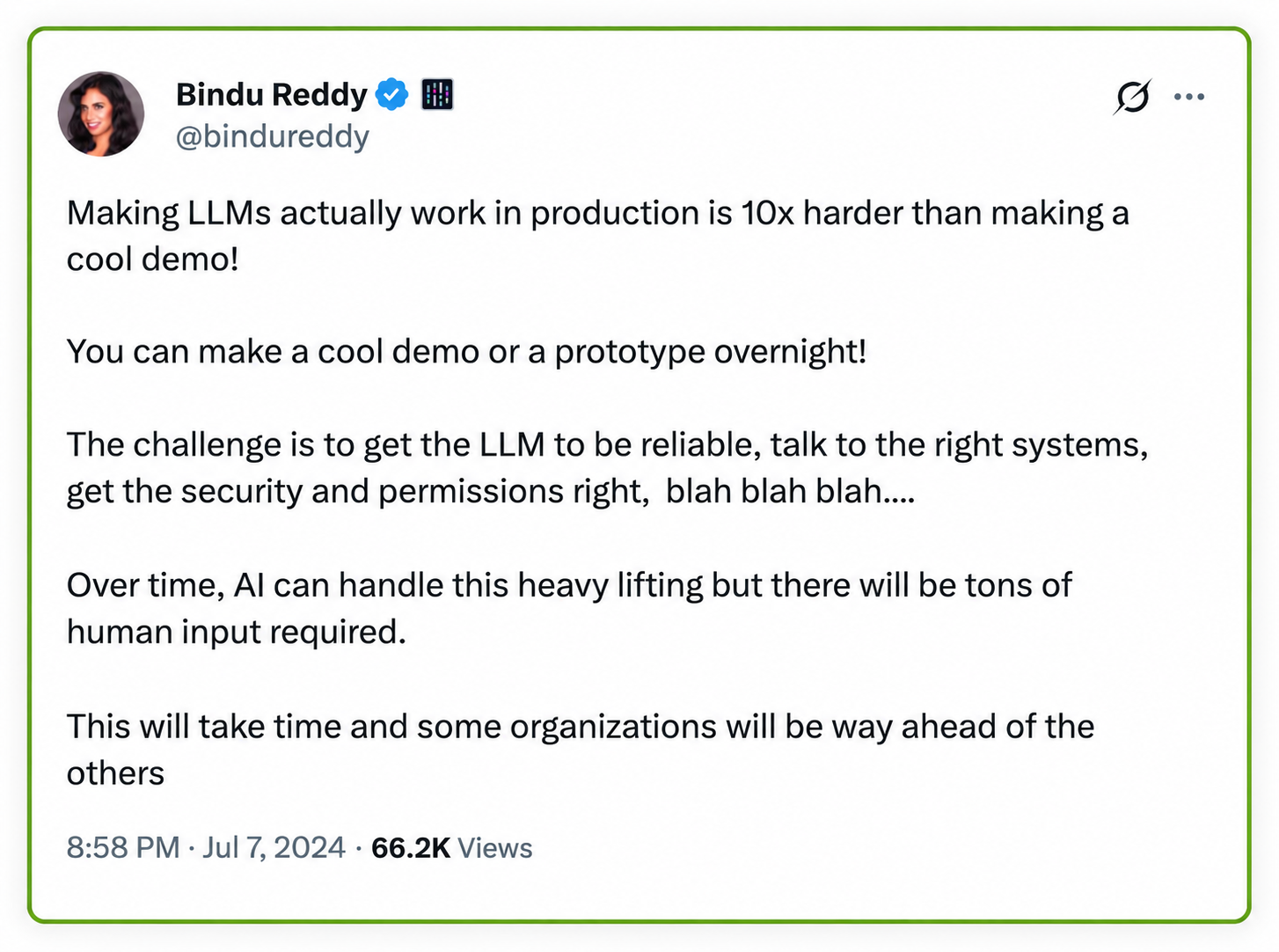
We hear a mix of conversations that show genuine excitement about what AI could theoretically do, curiosity about where to begin, and a growing skepticism born from pilots that never shipped.
At the same time, the software industry was processing its own moment of reckoning. SaaS valuations collapsed in early 2026 as investors began pricing in a world where AI agents could do the work that per-seat software licenses had been paid to enable. Analysts called it the "SaaSpocalypse."
The narrative spread fast: enterprise software was dying, and platforms like Salesforce and HubSpot were next.
Why Enterprise Software Is Not Actually Dying
The displacement story is more complicated than the headlines suggest.
Platforms like Salesforce or SAP are not simply systems of record — they are where teams spend the majority of their working day. To displace one would require:
- Full-Team Migration Challenges: Every team that touches it to migrate must move simultaneously as a partial migration can create two systems of record (which is worse than one legacy system).
- Budget, Procurement, and Approval Delays: Rip-and-replace AI projects need budget alignment, procurement approval, and a business case that can survive leadership changes.
- Executive Conviction and Risk Concerns: Leadership must be certain the new system is ready before decommissioning the old. That certainty almost never exists at the moment it is needed.
Those three conditions almost never align.
The switching cost is not primarily technical. It is organisational and temporal and that makes the moat around incumbent platforms far harder to breach than any product advantage alone.
What is changing is not which software enterprises run. It is how they consume it. The interface is shrinking. The intelligence layer sitting above it is growing.
At Gyde, we saw this firsthand.
Working with enterprises like Muthoot Fincorp, we learned that the challenge was rarely replacing enterprise software. It was helping people get more value from the systems already in place.
Real-Time Software Training and Contextual Support in Lending Operations
Gyde helped Muthoot Fincorp's agents learn and use their customer acquisition system in real time and in their own language — processing loans faster, with fewer errors, and driving better ROI from their existing software.
As AI entered the enterprise, that understanding became increasingly important.
Because if enterprise software wasn't disappearing, AI wouldn't replace those systems either. It would need to work with them.
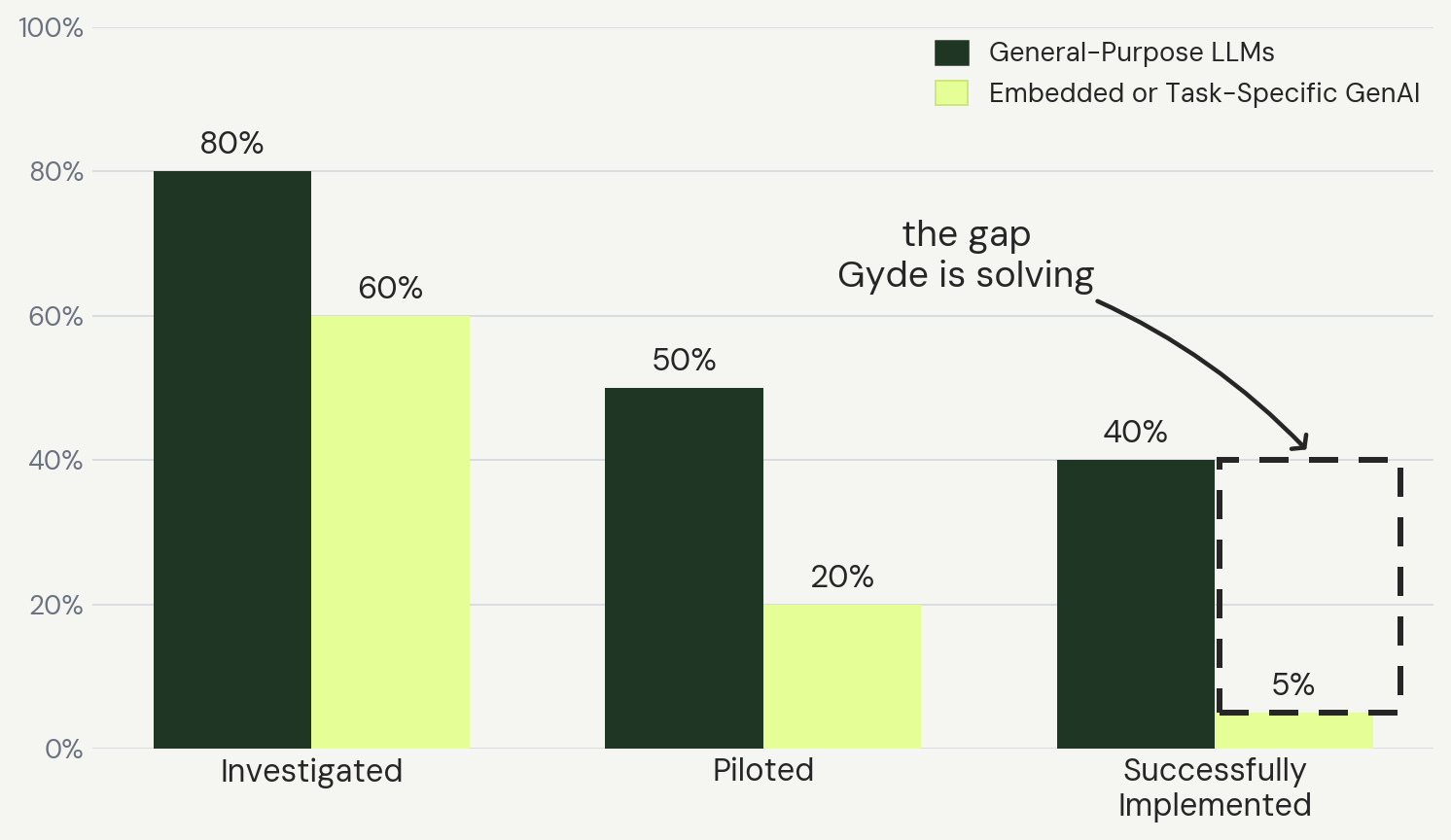
The reason enterprises are facing the challenge we mentioned in the introduction is simple: they are done experimenting with AI. They're trying to operationalize it.
Enterprises Have Started Taking "AI Pilot to Production" Seriously
This is the central tension Gyde observes in every enterprise conversation in 2026.
What AI can do in an enterprise (AI capability) is extraordinary. Technologies such as RAG, MCPs, orchestration frameworks, and agent tooling have expanded what's technically possible.
But assembling these components into reliable, production-grade systems remains difficult for most enterprises.
Why The AI Adoption Gap Exists
After working across industries at scale, Gyde has found that the same three problems appear in nearly every enterprise AI initiative that stalls before reaching production.
01. Rapidly evolving models, platforms, and tools:
The landscape shifts faster than internal teams can evaluate, pilot, and commit to. By the time a tool clears procurement, something better has launched. Decision paralysis sets in.
02. Low AI talent density inside enterprises:
The engineers who can build and run production AI systems are rare and concentrated in a handful of technology companies. Most enterprises simply do not have them on staff.
03. Lack of business context and the right data:
AI without the right data and business logic is a general-purpose tool trying to solve specific problems. Without context embedded from the start, models misfire and lose trust fast.
The Enterprise AI Trap
No Measurable ROI
Pilots launch. Business value remains difficult to prove.
Investment Pullback
Budgets tighten as confidence in AI initiatives declines.
Benefits Stay Theoretical
Efficiency and automation remain promises rather than outcomes.
Back to Square One
The search restarts while competitors continue building capability.
What Is a Specific Intelligence System and How Does It Work in Practice?
A Specific Intelligence System is an AI framework built around one clearly defined operational bottleneck within an enterprise environment.
| SIS is not... | Because that would mean... |
|---|---|
|
01
Generic AI Platform
|
AI capability without ownership of outcomes |
|
02
Workflow Automation Tool
|
Moving tasks without understanding decisions |
|
03
Staff Augmentation
|
Scaling labor instead of scaling expertise |
|
04
One-Size-Fits-All Product
|
Treating every enterprise process the same |
|
05
Demo-Grade AI
|
Intelligence that never survives production realities |
General AI is impressively capable and broadly unreliable in enterprise contexts. Specific AI (trained on the right data, scoped to the right workflow, governed with the right guardrails) is what produces the ROI that justifies further investment.
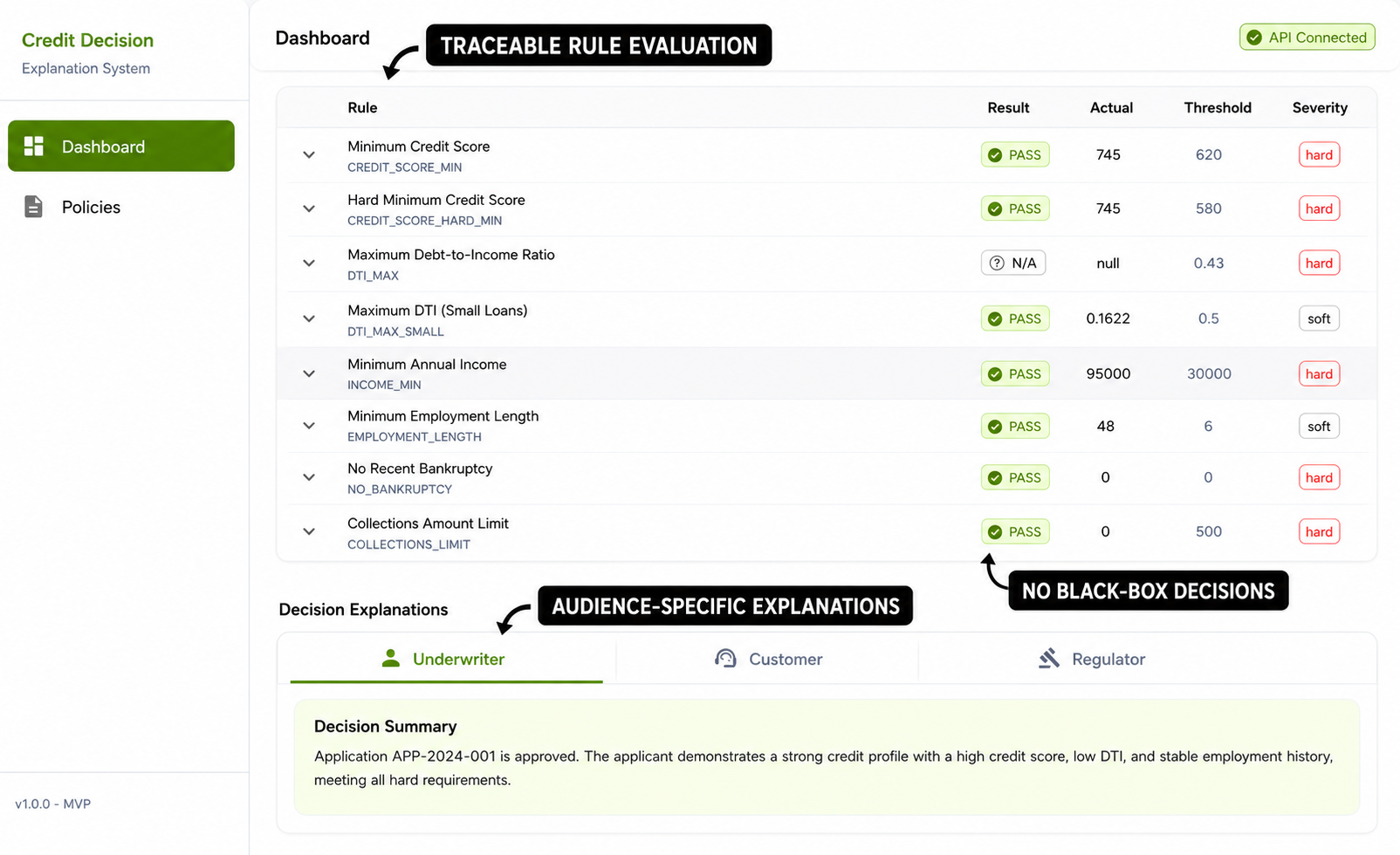
Now, let's imagine a real scenario of an underwriter reviewing a new loan application.
- Unlike a generic AI system, the CRE underwriting SIS doesn't follow a universal decision model.
- It follows the organization's own underwriting policies, approval criteria, risk thresholds, and exception workflows.
- Every rule is evaluated against the applicant's data, creating a traceable decision path from input to outcome.
- The result is an explainable underwriting process that reflects how the business operates.
Does this mean Gyde is no longer a Digital Adoption Platform?
Not really.
The need for in-the-flow-of-work guidance hasn't disappeared. Employees still need contextual support, training, and assistance within the applications they use every day.
What's changed is the scope of the problem.
Today, enterprises need more than training in the flow of work. They need intelligence in the flow of work.
That's why Digital Adoption remains a part of what Gyde does. But instead of offering a generic platform for any workflow, we're building specific intelligence solutions for specific business processes—whether that's loan origination, claims processing, email compliance, or other enterprise-critical workflows.
In other words, we haven't abandoned digital adoption. We've built on top of it.
Closing the gap between software capability and human adoption
In-app guidance and real-time nudges that help people use complex software well.
"We've always built the bridge. The river just got wider (due to AI & constantly evolving tech)."
Closing the gap between AI capability and production deployment
Specific Intelligence Systems — so AI stops being a pilot and starts driving real outcomes.
The Bottom Line: The Future Belongs to Systems
The past few years have been dominated by conversations about models. Which model is smartest. Which benchmark is highest. Which announcement resets the race.
But enterprises rarely fail because they picked the wrong model. They fail because intelligence never makes it into production.
The winners of the next decade won't be the organizations with access to the most AI. They'll be the ones that can reliably turn AI capability into repeatable business outcomes.
That's the shift we're seeing. From experimentation to operationalization.
And it cannot be achieved without systems in place.
Frequently Asked Questions
Q. What is a Specific Intelligence System?
Answer: A Specific Intelligence System (SIS) is a production-grade AI system built for one defined enterprise use case. Unlike general-purpose AI tools, an SIS is scoped to a specific workflow, connected to relevant business data, and governed with compliance guardrails from the start.
Q. How is an SIS different from an AI agent?
Answer: AI agents are general-purpose by design. An SIS is deliberately narrow, built to do one thing reliably in production rather than many things experimentally. The specificity is what makes it trustworthy enough for enterprise deployment.
Q. Why do enterprise AI pilots fail to reach production?
Answer: These are some root causes. Firstly, the AI landscape shifts faster than procurement cycles. Then, enterprises lack the internal talent to build and run production AI, and most pilots are never connected to the business data and logic that make them useful.
Q. What is the LLM Sandwich architecture?
The LLM Sandwich is Gyde's core technical approach which wraps a language model between deterministic pre- and post-processing layers. The pre-layer validates inputs and injects business context. The post-layer enforces format, checks compliance, and validates outputs before they reach users.
Q. Which industries does Gyde build Specific Intelligence Systems for?
Gyde focuses on (BFSI, Healthcare, and Retail) verticals where workflow complexity, compliance requirements, and data sensitivity make production-grade AI both harder and more valuable to deploy correctly.